How Does an Electric Car Jack Work Step by Step
Changing a flat tire or lifting your vehicle can be stressful, especially when a traditional jack feels slow, heavy, or difficult to use. You’re not alone—many drivers want a safer, easier way to handle roadside repairs.
In this guide, we’ll explain how an electric car jack works step by step and what to look for when choosing one.
An electric car jack uses your vehicle’s battery or outlet to power a motor. First, you park on level ground, engage the brake, and check the jack.
You position its saddle at an approved lift point, connect the controller, and press the lift button.
The motor turns gears and a screw or pump, raising the vehicle steadily.
Stop at the recommended height and place jack stands underneath.
Remove them before lowering slowly.
Continue for detailed safety and troubleshooting guidance.
Key Takeaways
- Park on level ground, engage the parking brake, turn off the vehicle, and position the jack at an approved lift point.
- Connect the jack to the correct power source, inspect the cables and components, and briefly test the controls.
- Press the lift button. The motor drives gears, a screw, or a hydraulic pump to raise the saddle steadily.
- Stop at the recommended height, confirm stability, and place properly rated jack stands beneath approved support points.
- Remove the stands carefully, lower the vehicle slowly, disconnect the power, and inspect and store the jack safely.
Check Safety Before Using an Electric Car Jack
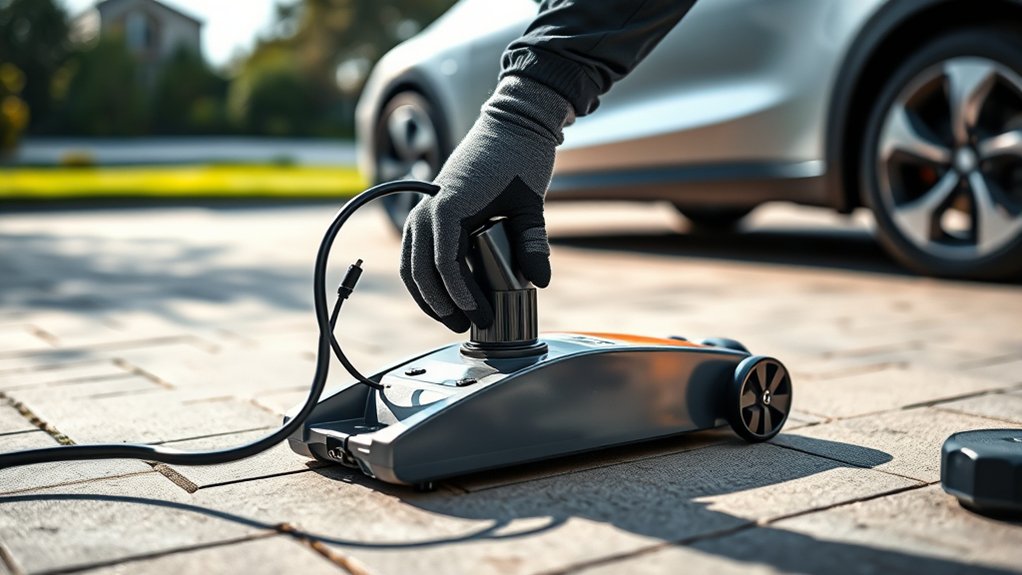
Before using an electric car jack, park on a flat, stable surface and switch off the vehicle. Engage the parking brake, place the transmission in Park or first gear, and turn on your hazard lights if you’re near traffic.
Check the ground for oil, gravel, ice, or slopes that could make the jack shift. Keep passengers away, and don’t work beneath a vehicle supported only by the jack. Use properly rated jack stands after lifting.
Inspect the jack, power cord, remote, and lifting pad for cracks, frayed wires, or loose connections. Follow the manufacturer’s weight limit and confirm it suits your vehicle.
Battery maintenance matters, so keep the battery clean, dry, and adequately charged. Review the charging procedures before connecting it, and use only the specified charger and outlet.
Never charge a damaged battery or operate the jack in standing water. Wear gloves, keep your hands clear of moving areas, and stay alert throughout the lift.
Learn the Jack’s Main Parts
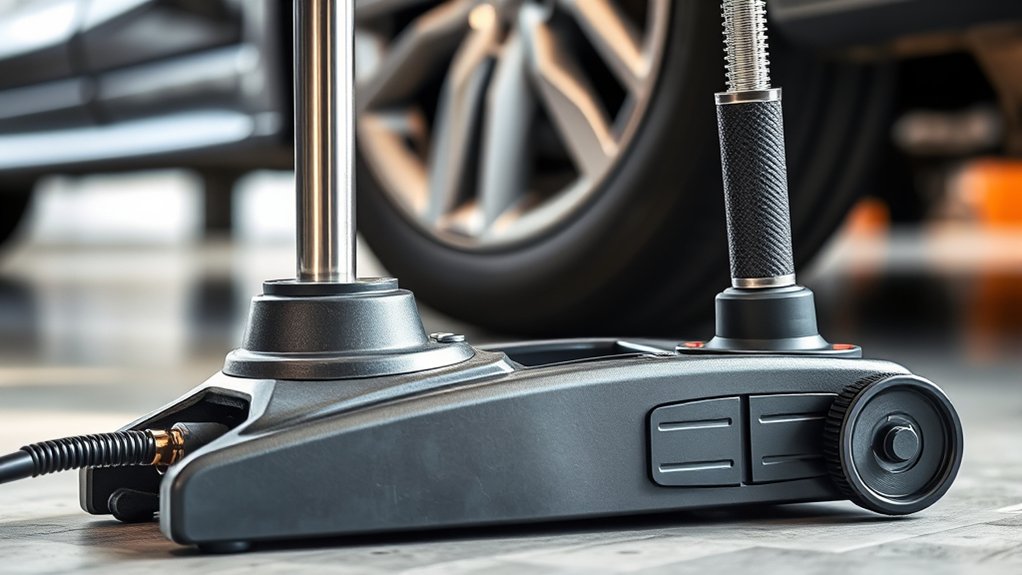
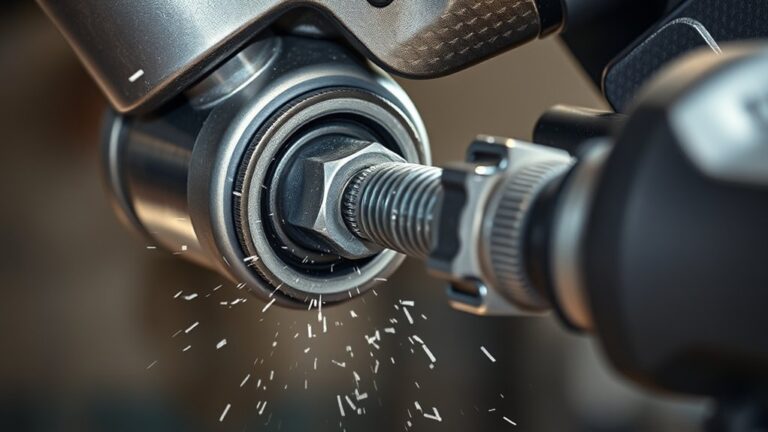
To understand how your electric car jack works, start with the motor and gearbox. They power the lifting mechanism.
Next, take a look at the lifting arm and saddle. These parts raise and support your vehicle.
Knowing what each part does’ll help you use the jack safely and effectively.
Motor And Gearbox
The motor powers the electric car jack, while the gearbox converts its rapid rotation into the slower, stronger movement needed to lift your vehicle.
When you connect power, the motor spins its shaft and supplies torque. This Motor function gives the jack controlled energy instead of relying on manual effort.
Inside the gearbox, interlocking gears reduce speed and multiply torque. That Gear operation lets the mechanism handle the vehicle’s weight steadily while limiting strain on the motor.
| Part | Primary job |
|---|---|
| Motor | Produces rotational power |
| Gearbox | Increases torque |
| Gears | Transfer controlled motion |
You’ll typically hear a steady whir as these parts work together. The control switch regulates power, while the gearbox maintains smooth output.
Proper lubrication reduces friction, and durable metal gears improve reliability. Keep this assembly clean and inspect it regularly for unusual noise.
Lifting Arm And Saddle
Once the gearbox delivers controlled torque, the lifting arm raises the saddle beneath your vehicle’s designated lift point. This movement converts the motor’s rotation into steady vertical force, letting you lift the car without manually pumping a handle.
- Lifting arm: The hinged steel arm extends gradually, supporting the load as it rises. Its joints guide movement and help prevent sudden shifts.
- Saddle: The padded saddle contacts your vehicle’s approved lifting point, distributing pressure and protecting the underside from damage.
- Alignment: You should center the saddle before lifting. An offset contact can make the vehicle unstable.
- Stability: Keep the jack on firm, level ground. Stop if the arm twists, slips, or makes unusual noises.
Don’t crawl beneath a vehicle supported only by the jack. Once you reach the required height, place approved jack stands before working underneath.
Power an Electric Car Jack Safely
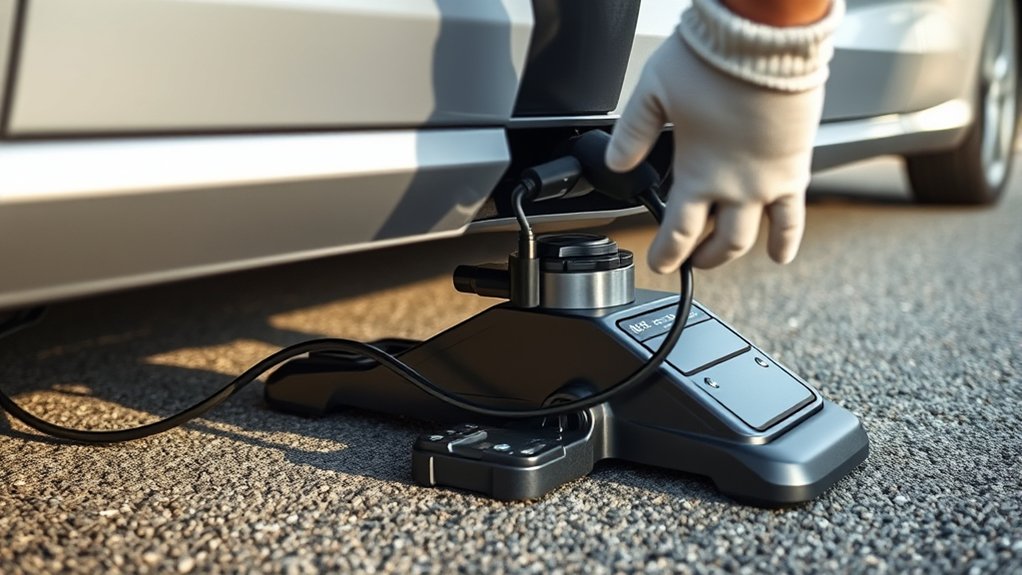
Before powering your electric car jack, check all connections for damage or looseness. Use only the voltage specified by the manufacturer—don’t guess. Following these precautions helps protect you and prevents damage to the equipment.
Check Power Connections
How can you safely power an electric car jack? Start by checking every power connection before lifting your vehicle. Park on level ground, switch off the jack, and inspect the battery, cables, plug, and control switch for damage, moisture, or looseness. Don’t use frayed wires or corroded terminals.
- Clean battery terminals with a suitable brush, then tighten connections securely.
- Confirm the power cable seats fully in the jack and vehicle outlet.
- Keep connectors dry, away from oil, and clear of sharp edges.
- Test the control switch briefly while the jack remains unloaded.
Good Battery maintenance helps prevent weak starts and overheating. Follow the manufacturer’s Charging procedures, and stop immediately if you notice sparks, smoke, unusual heat, or a burning smell.
Repair or replace faulty components before operating the jack. Never bypass a fuse or safety connector.
Use Proper Voltage
Use the voltage specified in your electric car jack’s manual and on its rating label. Match your vehicle’s power source to the jack’s requirements before you connect it.
Check whether the model needs 12 volts, another direct-current rating, or a dedicated adapter. Proper voltage regulation keeps the motor operating consistently and helps prevent poor lifting performance caused by an underpowered supply.
Too much voltage can overheat internal components and damage the jack, while too little may cause the motor to stall or fail to lift the load.
Confirm battery compatibility if you’re using a portable power station, replacement battery, or external pack. Read its output specifications, not just its capacity.
Don’t assume every car battery, adapter, or jump starter supplies the correct voltage for your jack.
Follow Safety Precautions
Follow basic safety precautions whenever you power an electric car jack. Park on level ground, switch off the vehicle, engage the parking brake, and keep passengers away. Check your owner’s manual before connecting power, and don’t operate a damaged jack, cable, or plug.
- Inspect the jack, lifting pad, and battery for cracks, leaks, or loose connections before use.
- Follow the recommended Charging procedures. Use the correct adapter, keep the charger dry, and unplug it when charging finishes.
- Practice proper Battery maintenance by cleaning terminals, checking charge levels, and replacing swollen or weak batteries promptly.
- Position the jack beneath the manufacturer-approved lifting point, raise the vehicle slowly, and place jack stands before working underneath.
Never exceed the rated load. Stop immediately if you notice overheating, unusual sounds, sparks, or instability, and lower the vehicle safely if possible. Always wear gloves and protective footwear.
Position the Jack at the Lift Point
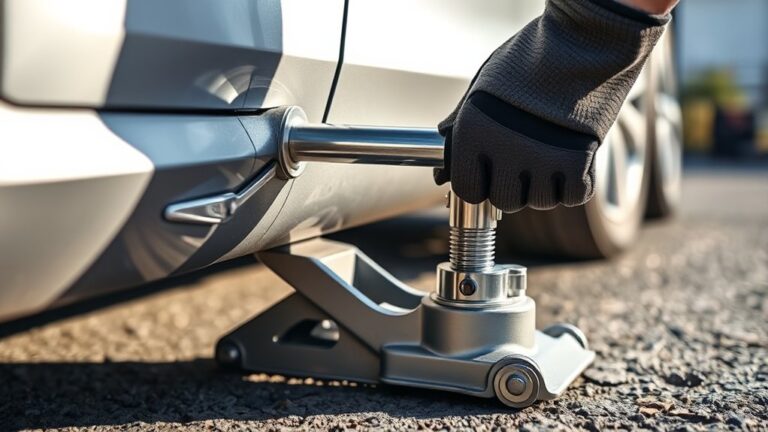
Once the electric car jack is near the vehicle, align its lifting pad with the manufacturer-designated lift point. Check your owner’s manual to identify the correct location, since each vehicle’s reinforced points may differ.
Keep the jack on firm, level ground, and position it squarely beneath the point without tilting. Confirm the lifting pad contacts the approved support area, not plastic panels, floor pans, or suspension components.
Clear loose gravel, ice, or debris that could make the base unstable. Before raising the vehicle, confirm the transmission is in park, engage the parking brake, and secure the opposite wheels with chocks.
Inspect the jack for damage, and check that its frame, lifting pad, and hydraulic fluid system appear sound. Battery maintenance also matters; a properly charged battery helps the jack operate reliably when needed.
Don’t place any part of your body beneath the vehicle while positioning or lifting it. Recheck alignment before proceeding.
Connect the Cable and Controller
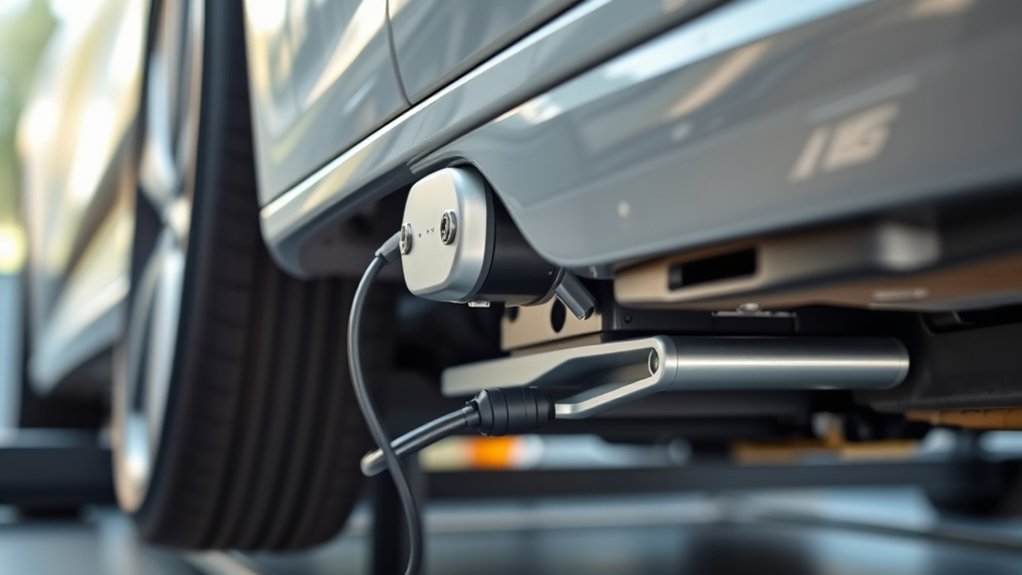
Connect the jack’s power cable to the controller and then to the vehicle’s 12-volt outlet or battery terminals, depending on the model. Keep the vehicle switched off while you make each connection.
Check your manual first, because battery compatibility and polarity requirements vary between electric jacks.
Always consult the manual first, since electric jacks may require specific batteries and polarity configurations.
- Inspect the cable, plug, fuse, and controller for cuts, bent pins, moisture, or loose parts.
- Match the red lead with the positive terminal and the black lead with the negative terminal. Never reverse them.
- Seat every connector firmly, then place the controller where you can reach it without standing near the vehicle’s underside.
- Review the listed charging methods, such as direct battery connection, a 12-volt socket, or an approved adapter. Don’t use an extension or power source that exceeds the jack’s rating.
Once connected, confirm that the controller’s indicator light shows normal power. If it stays dark, disconnect everything and recheck the fuse, outlet, battery terminals, and cable orientation before continuing.
Start Lifting With the Electric Motor
Press the controller’s lift button to activate the electric motor. It will engage the lifting mechanism and begin raising your vehicle. As the lift starts, make sure the jack remains securely positioned.
Motor Activates
When you activate the electric car jack, its motor converts electrical energy from the vehicle’s battery or power outlet into mechanical motion. You’ll hear a steady hum as the motor’s internal components begin rotating. The control switch regulates current flow, allowing you to start or stop operation smoothly.
Before use, inspect these essentials:
- Confirm the battery delivers adequate power.
- Check connections for looseness, corrosion, or damage.
- Keep the motor vents clear for proper airflow.
- Watch for unusual noise, odor, or vibration.
Good Battery maintenance helps preserve reliable output and reduces strain during operation.
If the motor runs too long without a break, motor overheating can occur, potentially triggering an automatic safety cutoff. You should stop immediately if the unit becomes excessively hot.
At this stage, the motor only initiates powered operation; the jack’s lifting mechanism hasn’t yet engaged. Follow the manufacturer’s operating limits for safe, consistent performance.
Lifting Mechanism Engages
Once the motor reaches operating speed, its rotating force engages the jack’s lifting mechanism. You’ll see the drive screw, gears, or pump transfer that power into upward motion.
In a screw-type jack, the motor turns a threaded shaft, while a mechanical linkage extends the lifting arms. In a hydraulic design, the motor drives a pump that builds hydraulic pressure, pushing a piston upward.
As the saddle rises, you should keep the vehicle centered and watch for stable contact.
| Component | Action |
|---|---|
| Motor | Supplies rotation |
| Gears | Increase torque |
| Screw | Converts rotation |
| Linkage | Extends arms |
You’ll hear a steady hum as resistance increases. The control circuit monitors current and may stop the motor if the load becomes excessive.
Don’t place any part of your body beneath the car until you’ve secured it with properly rated jack stands.
Understand How the Gears Lift the Car
The electric motor turns a series of gears that multiply its force and transfer it to the jack’s lifting screw. As you operate the control, each gear reduces speed while increasing torque, giving the screw enough power to raise the vehicle’s weight.
The Gear mechanism converts fast motor rotation into controlled upward movement without requiring you to pump a handle. Unlike Hydraulic operation, which uses pressurized fluid, this electric system relies on mechanical force and a threaded screw.
The gear mechanism transforms rapid motor rotation into steady lifting power through mechanical force and a threaded screw.
- The motor spins the input gear.
- Larger reduction gears increase torque.
- The final gear rotates the lifting screw.
- The screw pushes the jack’s arms upward.
As the screw turns, its threads draw the moving arms together or apart, depending on the jack’s design. That movement transfers force through the frame and lifting saddle.
You’ll hear the motor work harder as resistance rises, but the gear reduction keeps the motion steady. Built-in protection may limit current if the load becomes excessive, helping prevent motor or gear damage during lifting.
Stop at the Right Height and Add Jack Stands
Stop the electric jack when the vehicle reaches the manufacturer’s recommended lifting height, then release the control. Keep your hand off the switch and confirm that the car sits evenly on the jack’s lifting pad.
Check the vehicle manual for approved support points. Never place a stand beneath the battery pack, rocker panel, suspension arm, or another unapproved area.
Position jack stands at those points, adjusting their height so they contact the structure without lifting the car farther. Use two stands on the same axle, or follow the manufacturer’s specified support arrangement.
Before relying on them, inspect each stand for damage and verify that its locking mechanism engages fully. Your electric jack’s battery capacity may affect how long it can hold position, so don’t treat it as a substitute for stands.
Keep charging stations, cords, tools, and bystanders clear of the work area. Once the stands carry the vehicle securely, leave the jack positioned as a secondary support if recommended.
Lower the Vehicle Safely
With the vehicle supported by the stands, remove tools and people from beneath it before lowering. Confirm every stand sits squarely on solid ground, and keep your hands, feet, and cables clear of the tires.
- Reconnect the electric jack’s control, then position yourself beside the vehicle, never underneath it.
- Raise the vehicle slightly to unload the jack stands, then remove each stand carefully and keep them organized.
- Press the lower control briefly, using a slow, steady motion. Stop immediately if the vehicle shifts, tilts, or makes an unusual movement.
- Continue lowering until all tires contact the ground evenly. Release the control and verify the suspension has settled.
Apply the parking brake, select Park, and switch off the jack. Remove wheel chocks only after confirming stability.
Store the jack dry, inspect its cable, and follow battery maintenance guidance before its next use. Keep charging procedures separate from lifting work, and never operate the jack while its battery charges.
Perform a final walk-around before driving.
Troubleshoot Common Electric Jack Problems
When an electric jack won’t lift, lower, or respond, troubleshoot it before attempting another lift. Park on level ground, switch off the vehicle, and confirm the jack’s base sits firmly. Check the power connection, remote, fuse, and control switch for damage.
Don’t exceed the jack’s rated capacity, and never work beneath a vehicle supported only by it.
| Symptom | Likely cause | Action |
|---|---|---|
| Motor clicks | Weak battery | Recharge or replace it |
| Jack stops | Overload or heat | Reduce load and let it cool |
| No response | Loose cable | Secure every connection |
For dependable Battery maintenance, inspect terminals for corrosion, keep the battery charged, and store it in a dry place.
Follow the manufacturer’s Charging methods; use the supplied adapter rather than an improvised charger.
If the motor runs but the screw doesn’t move, stop immediately and inspect for bent parts or stripped gears. Don’t force the mechanism.
Contact the manufacturer if unusual noise, smoke, or repeated failure continues. Reset the jack only as the manual directs.
Frequently Asked Questions
Can an Electric Car Jack Lift Every Vehicle Type?
No, an electric car jack can’t lift every vehicle type. You’ll need to check its weight capacity, lifting range, and vehicle compatibility before using it.
Most models handle cars, crossovers, and some light trucks, but heavy-duty trucks, buses, and unusually high-clearance vehicles may exceed their limits.
Choose a jack rated above your vehicle’s gross weight, confirm the lifting points, and follow the manufacturer’s instructions. Never rely on the jack alone for support.
How Long Does an Electric Car Jack Typically Last?
An electric car jack typically lasts five to ten years with proper care, though your usage, load weight, storage conditions, and build quality affect its lifespan. You’ll get better results if you follow the manufacturer’s capacity limits and inspect cables, switches, and moving parts regularly.
Battery life depends on charging habits and age, while the power source matters too. Keep it dry, clean, and stored safely to extend reliable performance and prevent premature failure.
What Maintenance Does an Electric Car Jack Require?
You’ll keep an electric car jack reliable with simple maintenance. Inspect the hydraulic mechanism for leaks, dirt, or unusual resistance, and clean exposed parts regularly.
Check cables, connectors, and the power source for damage, corrosion, or weak performance. Lubricate moving joints as the manufacturer recommends, but don’t overapply grease.
Test the jack periodically without lifting a vehicle, tighten loose fasteners, and store it dry, covered, and safely secured.
Can an Electric Car Jack Be Used in Freezing Weather?
Yes, you can use an electric car jack in freezing weather, but you’ll need extra caution. Freezing effects can reduce battery capacity, stiffen lubricants, and make cables brittle or slippery.
Keep the jack and battery warm and dry before use, and inspect them for cracks or damage. Follow weather safety practices: park on level ground, use wheel chocks, avoid ice, and don’t operate the jack during heavy snow, standing water, or extreme cold.
How Should an Electric Car Jack Be Stored?
Store your electric car jack like a sleeping tool: clean, dry, and protected. For Storage safety, disconnect the battery, retract the lifting arm fully, and keep cables neatly coiled without tight bends.
Choose a cool, dry location away from moisture, heat, children, and corrosive chemicals. For Proper positioning, place the jack upright on a stable shelf or inside its case, preventing it from tipping, crushing, or collecting dust between uses.
Conclusion
Using an electric car jack is straightforward when you follow each step: inspect the equipment, connect power correctly, position it on the manufacturer’s lift point, and raise the vehicle gradually. Never work beneath a car supported only by the jack—add jack stands before starting repairs.
Most electric jacks lift a vehicle in roughly 60 seconds, but speed doesn’t replace caution. Lower the car slowly, disconnect power, and store the jack safely after every use. Following these steps helps ensure safe and effective electric car jack operation.