
Ceramic Coating Curing Time: What You Can and Cannot Do After Application
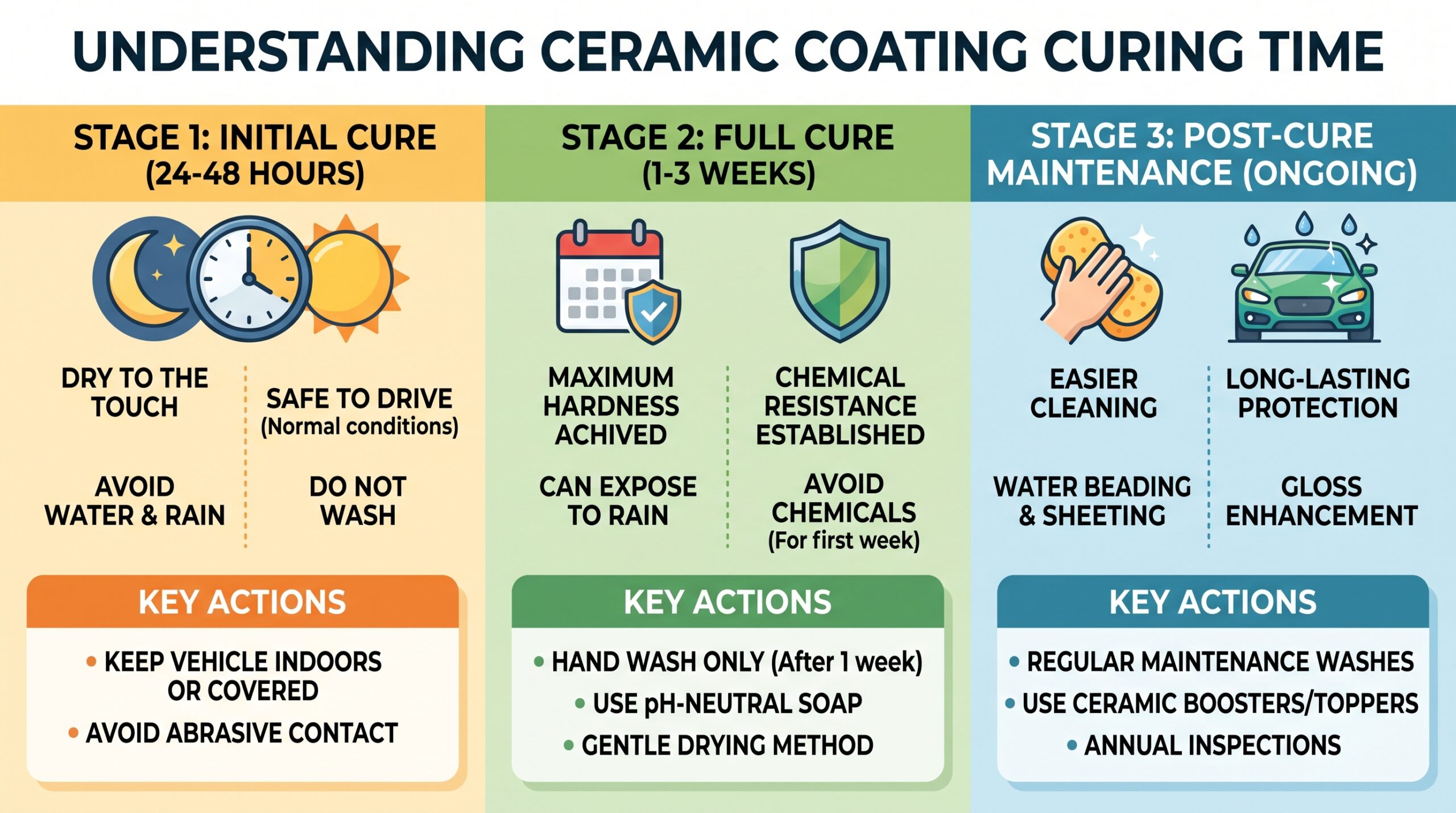
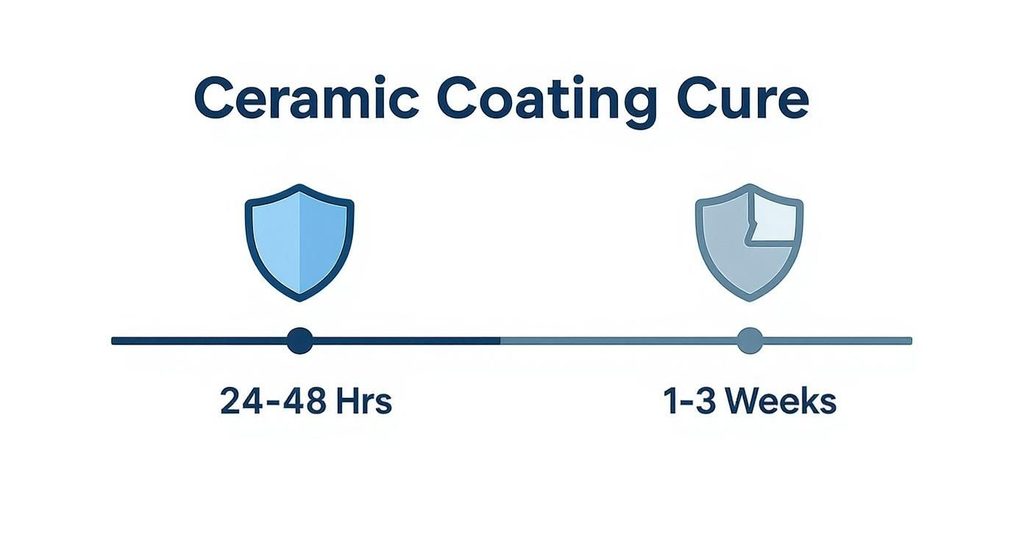
Quick Answer: Ceramic coating curing time happens in three phases: the coating is dry to the touch within 1 to 4 hours, forms initial chemical bonds within 24 to 48 hours, and reaches full 9H hardness and chemical resistance after 7 to 14 days. Avoiding water, soap, and direct sunlight-baked contaminants during this window is essential to protecting the coating’s final performance.
Driving away from a detailing studio after receiving a professional ceramic coating is an incredible experience. The paint looks dripping wet, reflections are laser-sharp, and colors carry deep, liquid clarity. However, the chemical process does not stop the moment you turn the key. While the coating feels dry to the touch upon delivery, it enters a critical chemical curing phase that dictates its ultimate hardness, gloss, and long-term durability.
Understanding ceramic coating curing time, and strictly adhering to aftercare rules during this window, is essential to protecting your investment.
The Science of Ceramic Coating Curing Time: Dry vs. Fully Cured
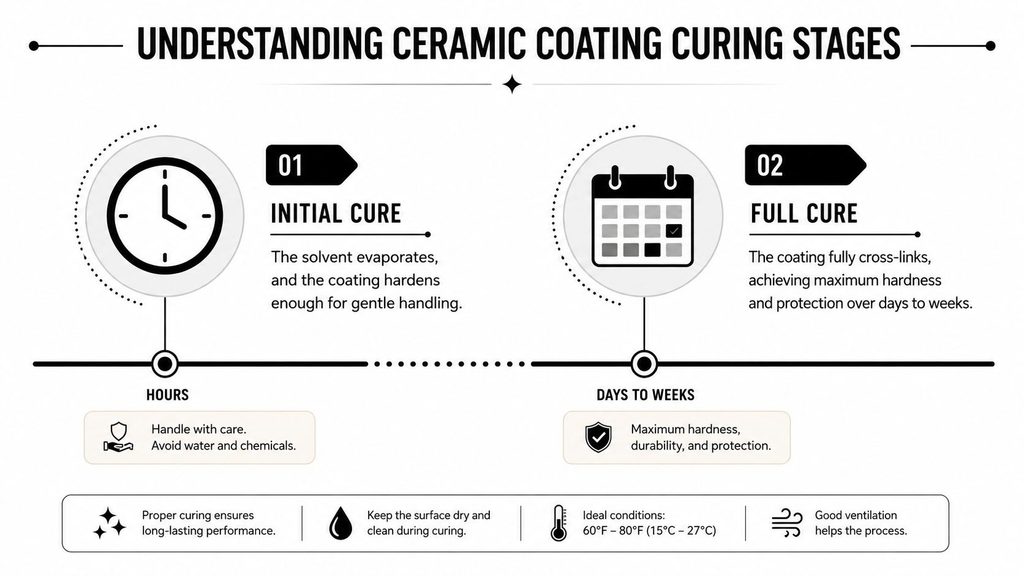
There is a fundamental difference between a coating being dry to the touch and being fully cross-linked, or cured. Ceramic coating curing time unfolds across three distinct phases, each with its own risks and rules.
Phase 1: Carrier evaporation (1 to 4 hours). The liquid solvent carriers evaporate, leaving behind the concentrated active solids, whether that’s SiO2 or nano-epoxy resins. At this stage the coating is dry to the touch, but nowhere near finished.
Phase 2: Initial cross-link (24 to 48 hours). The nanoparticles form initial covalent bonds with the vehicle’s clear coat. At this stage, moisture must be minimized, since the bonding process is still fragile.
Phase 3: Deep chemical cure (7 to 14 days). Over the next one to two weeks, the coating undergoes complete molecular polymerization with ambient oxygen and moisture, achieving its full scratch-resistant density and chemical tolerance, typically rated across a pH range of 2 to 13.
Professional Infrared Curing: Why Studio Curing Matters
At premier detailing studios like Red’s Detail Co., we do not simply let high-solids coatings, such as CQuartz Finest Reserve, air-dry at room temperature. We utilize short-wave infrared curing lamps that heat each panel to approximately 60 to 70 degrees Celsius, or 140 to 160 degrees Fahrenheit, for calibrated cycle times.
This process accelerates polymerization, since IR heat penetrates deep into the nano-layer and speeds up chemical bonding. It also achieves peak surface hardness immediately, increasing the initial hardness before the vehicle ever exits the cleanroom bay. Most importantly, it reduces vulnerability, drastically narrowing the critical window where moisture or dust could compromise the uncured finish. In short, professional IR curing meaningfully shortens the practical ceramic coating curing time an owner needs to worry about at home.
The Ceramic Coating Curing Time Timeline: What to Expect
| Timeframe | Coating Status | What You CAN Do | What You CANNOT Do |
|---|---|---|---|
| Hours 0-24 | Initial setup (in studio) | Controlled resting in climate-controlled bay | Exposure to rain, dew, sprinklers, or open roads |
| Hours 24-48 | Initial road-ready phase | Normal dry-weather driving | Getting car wet; parking under sap-dripping trees |
| Days 3-7 | Polymerization phase | Driving in rain if unavoidable; gentle spot rinse | Using car shampoos, soaps, or automated car washes |
| Days 7-14 | Final hardening phase | Light touchless water rinsing; blowing off dust | Heavy scrubbing, claying, or chemical cleaners |
| Day 15+ | Fully cured | First full two-bucket maintenance hand wash | Visiting automated brush car washes, ever |
This timeline is the clearest way to visualize ceramic coating curing time as a gradual process rather than a single fixed date, since what’s safe to do changes meaningfully from one phase to the next.
The “Do Not” List: 5 Rules for the First 14 Days
To prevent permanent water spot etching, streaking, or coating failure, follow these rules during the initial 14-day curing cycle, which represents the most sensitive portion of ceramic coating curing time.
1. Do Not Wash the Vehicle With Any Soaps or Chemicals
Even the gentlest pH-neutral automotive shampoo, such as CARPRO Reset, can interfere with the cross-linking nano-polymers during the first two weeks. Zero detergents should touch the paint for 14 days, no matter how mild the product claims to be.
2. Avoid Standing Water and Morning Dew During the First 48 Hours
If your vehicle gets caught in a sudden rain shower during the first 48 hours of ceramic coating curing time, do not panic, and do not scrub the wet car with a dry rag. Instead, gently blow the water droplets off with a leaf blower, or softly dab, rather than wipe, standing droplets using an ultra-plush, clean microfiber towel.
3. Do Not Park Under Trees or Near Industrial Sprinklers
Trees release sticky sap, pollen, and attract birds, all of which can bond aggressively to a coating that hasn’t finished curing. Hard water from lawn sprinklers also contains dissolved calcium and magnesium minerals that can permanently etch into a semi-cured coating under hot sun exposure, making this one of the more overlooked risks during ceramic coating curing time.
4. Remove Bird Droppings Immediately, Using Water Only
If a bird targets your vehicle during the cure window, saturate the droppings with distilled water to soften them, then gently lift the droppings away with a damp microfiber towel without applying downward pressure. Do not use chemical detailers or bug removers at this stage, since introducing any chemical agent during ceramic coating curing time risks disrupting the bond that’s still forming.
5. Never Apply Waxes, Sealants, or Coatings on Top
Layering a paste wax or synthetic sealant over a freshly applied ceramic coating suffocates the curing matrix, preventing oxygen from finishing the cross-linking process and ruining the hydrophobic finish. This mistake alone can undo weeks of careful ceramic coating curing time management in a single afternoon.
What Happens If It Rains During the Cure Period?
If it rains within the first few days of application, the primary risk is hard water spotting. Rainwater picks up environmental acids and minerals in the atmosphere, and because the ceramic layer is still reaching its final hardness during this stretch of ceramic coating curing time, allowing mineral-heavy raindrops to sit and bake under direct sunlight can cause surface water marks.
The fix is straightforward: if the car gets rained on, park it in a covered garage or blow off standing moisture before direct sunlight bakes the droplets onto the panels. Acting quickly during this window matters more than almost any other single habit during the entire curing process.
Does Ceramic Coating Curing Time Vary by Product Tier?
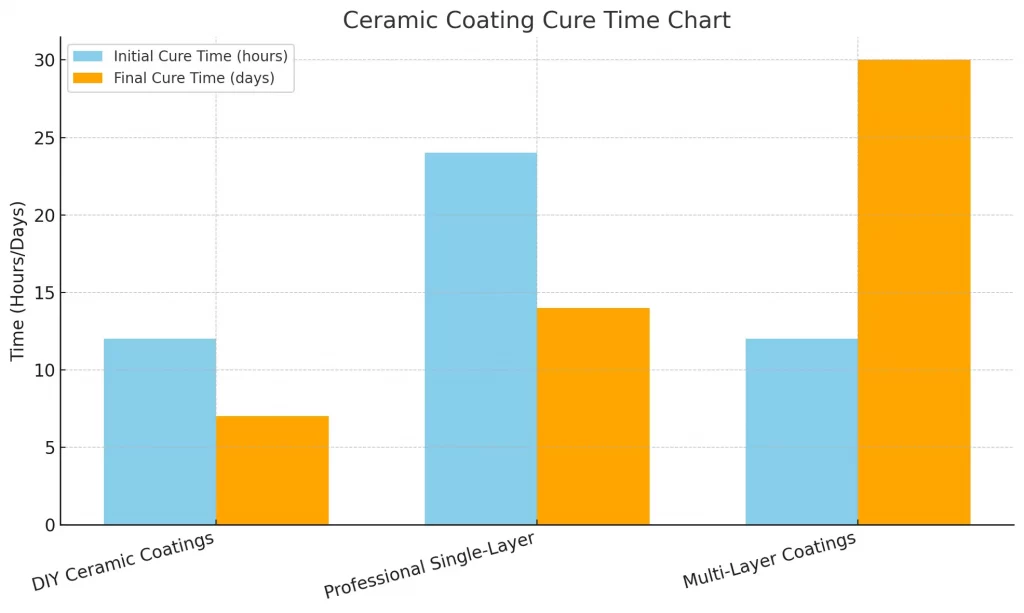
Yes, and understanding this variation helps set realistic expectations depending on which coating was installed. Consumer-grade spray coatings often reach a usable state faster, sometimes within a day or two, but they also never develop the deep cross-linked hardness that professional systems achieve, since their chemistry simply isn’t built for a multi-week polymerization process in the first place. Mid-tier professional coatings typically follow a curing schedule close to the standard 7-to-14-day window outlined above.
Flagship systems like CQuartz Finest Reserve, particularly when cured with infrared heat lamps, often reach a safe road-ready state faster than the timeline would suggest, though the full 14-day window still applies for washing and heavy environmental exposure regardless of how quickly the surface feels hardened to the touch.
Common Mistakes That Extend or Ruin Ceramic Coating Curing Time
A handful of owner habits account for most curing-related problems we see in practice. Washing too early, even with a supposedly gentle shampoo, is the single most common mistake, since impatience to enjoy the new finish often outweighs the discipline needed to wait out the full window. Parking under trees during the first week is a close second, since sap and bird droppings are far more likely to bond permanently to a coating that hasn’t finished its chemical cure.
Ignoring weather forecasts is another frequent issue, since planning driving and parking around expected rain during the first 48 hours meaningfully reduces the odds of water spotting. Finally, assuming faster feels-dry means fully cured trips up many first-time coating owners, since the surface can feel hard and slick well before the deeper chemical bonding is actually complete.
How Climate Affects Ceramic Coating Curing Time
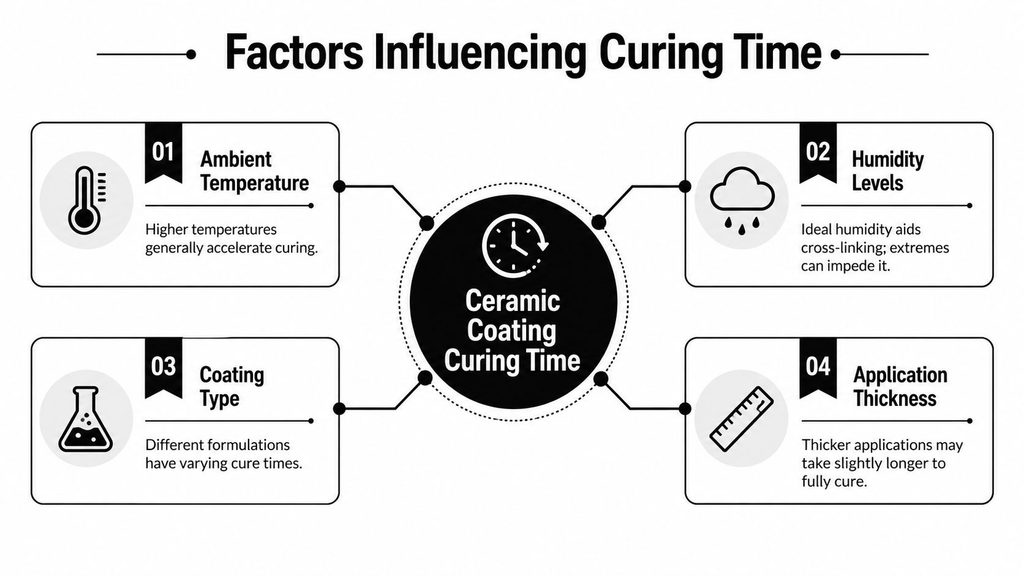
Local weather conditions can meaningfully speed up or slow down the practical curing experience, even when the underlying chemistry follows the same general timeline. Hot, dry climates tend to accelerate the visible hardening of the surface, though the full molecular cross-linking process still needs its complete window regardless of ambient temperature.
Humid climates, common throughout the Atlanta area for much of the year, can extend the practical caution period slightly, since higher ambient moisture in the air interacts with the curing chemistry and makes avoiding standing water even more important during the first 48 hours. Cold weather, on the other hand, slows the chemical reaction rate itself, which is one of the main reasons professional installers rely on infrared curing lamps rather than leaving temperature-sensitive coatings to cure at whatever the outdoor conditions happen to be that week.
Signs the Coating Cured Successfully
Once ceramic coating curing time has fully elapsed, a few clear signs confirm the coating bonded properly rather than being compromised along the way. Water should bead tightly into small, round droplets with a contact angle noticeably above 100 degrees rather than spreading or sheeting flat across the surface.
The paint should feel uniformly slick and glass-like to the touch across every panel, without any rough, tacky, or grabby patches that might indicate an area that didn’t fully cross-link. Gloss and reflection should also appear even and consistent panel to panel, since uneven curing sometimes shows up as subtle differences in depth or clarity between sections that received different amounts of infrared exposure during installation.
If any of these signs seem off once the full curing window has passed, it’s worth reaching out to your certified installer for an inspection rather than assuming it will simply resolve itself with more time. A properly cured coating shouldn’t need to “settle in” further after the 14-day mark; by that point, ceramic coating curing time has done essentially all the work it’s going to do.
Building Good Habits That Extend Beyond the Cure Window
Many of the cautious habits that protect a coating during its curing phase are worth carrying forward permanently, even once the strict 14-day rules no longer apply.
Avoiding automatic tunnel washes, addressing bird droppings and tree sap promptly, and using only pH-neutral shampoos are not just curing-period precautions; they’re the same practices that extend a fully cured coating’s multi-year lifespan. Thinking of the first two weeks less as a restrictive waiting period and more as an introduction to the maintenance mindset the coating rewards long-term tends to adjust feel more purposeful than simply counting down days until you can wash the car normally again.
Preparing Before Your Appointment to Simplify Curing
A little preparation before the installation appointment itself can make navigating ceramic coating curing time considerably easier once you get the car home, and it costs nothing beyond a bit of planning. Clearing a covered parking spot, whether that’s a garage, carport, or at minimum a spot away from trees and sprinkler lines, for the first two weeks removes one of the biggest sources of accidental exposure before it ever becomes a problem.
Checking the extended weather forecast and, where possible, scheduling the installation ahead of a stretch of dry days gives the coating its best possible start, since the first 48 hours are the most sensitive part of the entire process.
It also helps to plan around any car washes, road trips, or events that might tempt you to wash or drive through less-than-ideal conditions during the curing window. Owners who go in with a clear two-week plan almost always report an easier, less anxious experience than those who try to improvise around the rules after the fact, simply because they’ve already accounted for the inconvenience of ceramic coating curing time up front rather than discovering it mid-cure.
Frequently Asked Questions
Can I drive my car home from the detailing shop if it is raining?
At Red’s Detail Co., we use infrared heat curing to ensure the coating achieves an initial thermal cure before handover. However, if severe weather is forecast, we recommend keeping the vehicle in our indoor cleanroom until roads are dry, since driving through active rain during the earliest phase of ceramic coating curing time carries unnecessary risk.
When can I schedule my first maintenance wash?
Exactly 14 days after installation. At that point, ceramic coating curing time is complete, and you can resume regular bi-weekly hand washes using a pH-neutral shampoo. Our full ceramic coating maintenance guide covers the safe routine to follow from that point forward.
What if I accidentally washed the car with soap on day 5?
Inspect the paint in direct sunlight. If water still beads vigorously and there is no hazing, rinse thoroughly with fresh water and dry completely. Contact your certified installer for a quick surface evaluation, since an isolated early wash doesn’t always ruin the coating, but it’s worth having a professional confirm the bond wasn’t compromised.
Does ceramic coating curing time restart if I make a mistake partway through?
Not typically. A single accidental exposure to light rain or a quick rinse usually doesn’t reset the clock, since the chemical bonding that’s already formed remains intact. Repeated exposure to soap, heavy water, or chemical cleaners during the window is more likely to cause lasting issues than a single early lapse.
Is ceramic coating curing time the same for every panel on the vehicle?
Largely, yes, assuming even application and consistent curing conditions across the vehicle. Panels that receive less direct infrared exposure during the curing process, such as tucked-in areas near mirrors or door jambs, can occasionally cure slightly slower, which is one reason certified installers use calibrated, panel-by-panel curing cycles rather than a single blanket treatment.
Does the color of my car affect ceramic coating curing time?
Not the underlying chemistry, but darker colors absorb more heat from ambient sunlight, which can very slightly speed up the surface-level hardening an owner notices day to day. The deeper molecular cross-linking still follows the same general 7-to-14-day schedule regardless of paint color, so the standard aftercare rules apply equally to light and dark vehicles alike.
Flawless Installation and Aftercare at Red’s Detail Co.
At Red’s Detail Co., we treat paint preservation with scientific precision. From multi-stage surface decontamination and precision paint jeweling to cleanroom infrared curing, we ensure your CQuartz ceramic coating cures to peak resilience within a carefully managed ceramic coating curing time window.
Ready to give your vehicle lasting glass-like protection? Contact Red’s Detail Co. in Marietta today to schedule your consultation.
Related Reading on Our Site
- Top 10 Ceramic Coating Benefits
- Ceramic Coating vs PPF: Which Is Right for Your Car
- How Long Does Ceramic Coating Really Last
- What Is CQuartz Finest Reserve
- How to Wash and Maintain a Ceramic Coated Vehicle
- Is Ceramic Coating Scratch-Proof? Myths and Realities
- Ceramic Coating vs Wax: Which Is Worth the Investment
- How Much Does Ceramic Coating Cost
- Why Apply Ceramic Coating to a Brand-New Car Immediately
- Book a Consultation



4 Comments