2026 Ford Explorer: Engine Options and Towing Capacity — The Complete Review
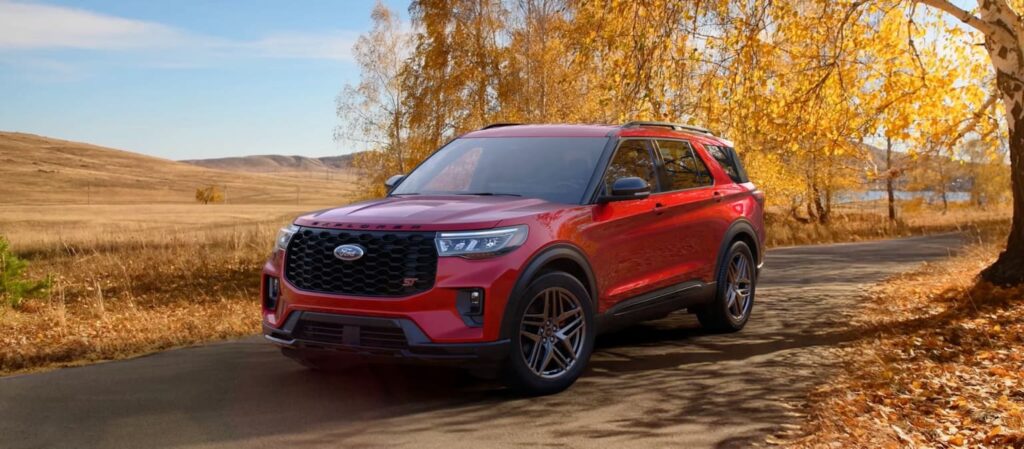
The 2026 Ford Explorer is an American institution that continues to evolve on its own terms. Few vehicles in automotive history have shaped the midsize SUV segment as fundamentally as the Explorer. The 2026 Ford Explorer was among the first true family SUVs to combine genuine three-row passenger space with rear-wheel-drive dynamics and a truck-capable powertrain, and it pioneered the formula that dozens of competitors have spent three decades attempting to replicate. The 2026 model year delivers a version of that formula that is sharper, more technologically sophisticated, and more capable off-road than any previous Explorer in the nameplate’s history.
The headline addition for 2026 is the all-new Tremor trim, which replaces the outgoing Timberline as the Explorer’s dedicated trail-capable variant. The Tremor is the first Explorer outside the ST to offer the 400-horsepower twin-turbocharged 3.0-liter V6 as an option — a significant development that gives buyers who want serious off-road capability access to the powertrain previously reserved for the performance-focused ST. Combined with a Torsen limited-slip rear differential, off-road-tuned suspension, skid plates, all-terrain tires, and an inch of additional ground clearance over standard trims, the Tremor answers a question Explorer enthusiasts have been asking for years.
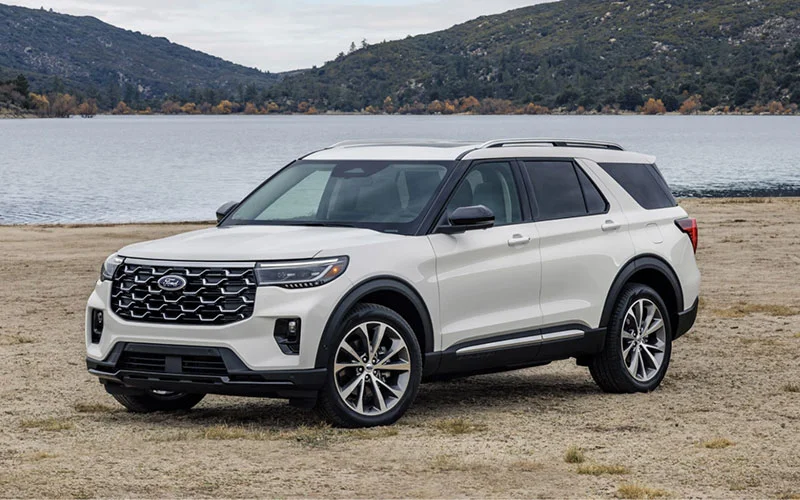
The broader 2026 lineup — six trims spanning from the value-oriented Active 100A to the performance-flagging Explorer ST — presents buyers with a more coherent and fully differentiated set of choices than the Explorer has offered in recent memory. A new lower entry point in the Active 100A, the sporty ST-Line, the adventure-ready Tremor, the luxury-forward Platinum, and the 400-horsepower ST each serve genuinely distinct buyer profiles. The Ford Digital Experience software platform, the 13.2-inch touchscreen, Google Built-in integration, and available BlueCruise hands-free driver assist give the Explorer a technology package that is competitive with any three-row midsize SUV on the market.
This review of The 2026 Ford Explorer covers both EcoBoost engine options, the complete six-trim lineup with verified pricing, towing capacity, off-road capability, interior design and technology, safety equipment, competitive positioning, and the honest trade-offs every prospective buyer deserves to understand.
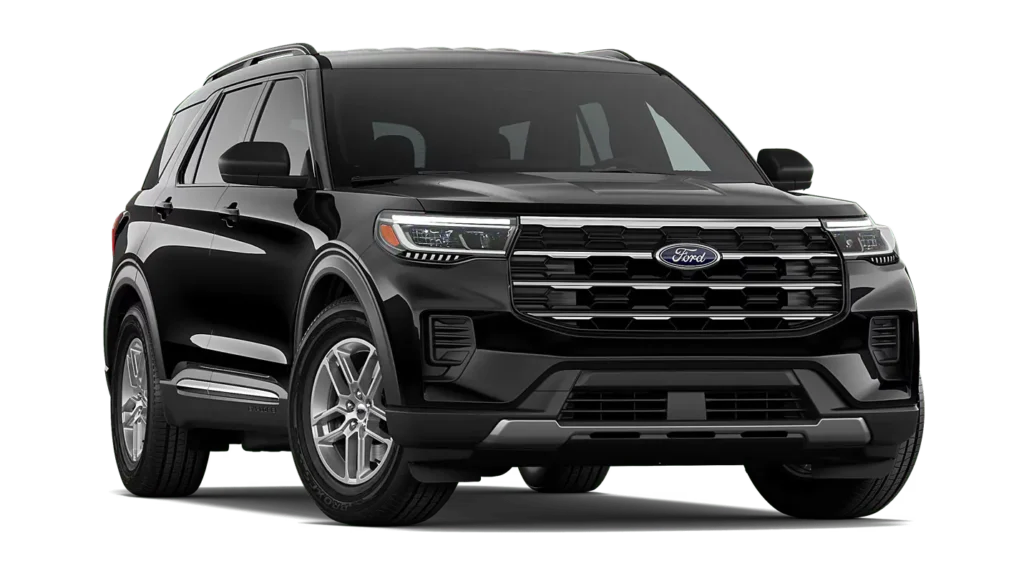
Why the 2026 Ford Explorer Remains Relevant in a Crowded Segment
The three-row midsize SUV segment has become intensely competitive. The Kia Telluride, Hyundai Palisade, Honda Pilot, Chevrolet Traverse, Toyota Highlander, and Volkswagen Atlas all compete for the same family buyer, and most of them have significantly closed the gap on the Explorer’s historical advantages in the past decade. The 2026 Ford Explorer’s continued relevance rests on three specific strengths that no other vehicle in the class simultaneously delivers.
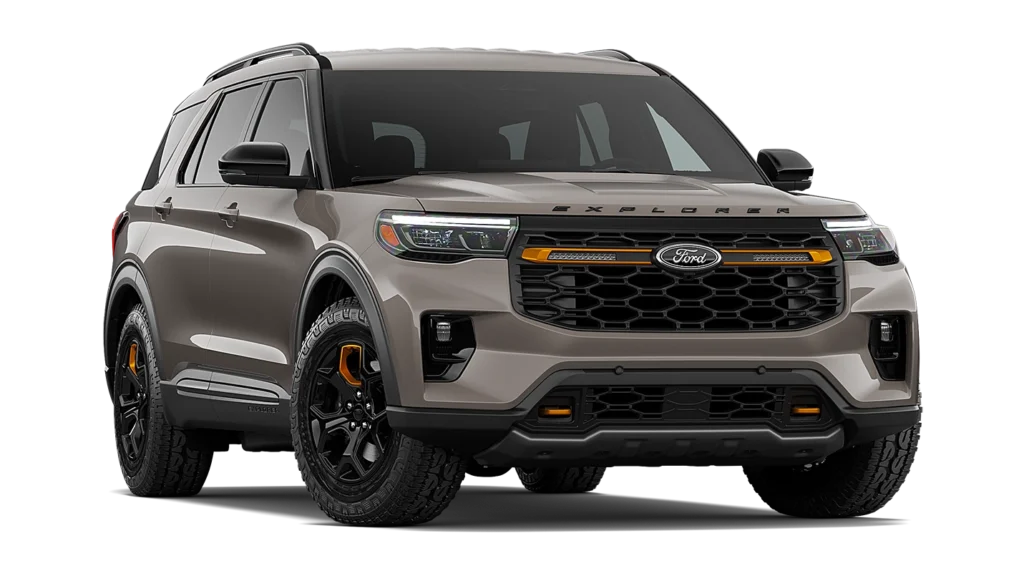
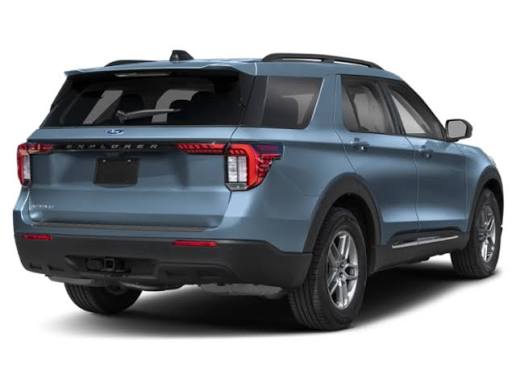
First, the rear-wheel-drive-biased platform remains genuinely distinctive. Rear-wheel drive is uncommon in this class, and it lends the Explorer a decidedly sporty driving experiencefor a family SUV. Even when equipped with all-wheel drive, the rear bias is noticeable and welcome. The handling character that results from this architecture is meaningfully different from the front-wheel-drive-biased crossovers that dominate the segment, giving the Explorer a driving engagement that family-SUV buyers who also enjoy driving will notice and value.
Second, the engine lineup is legitimately exceptional. The Explorer has one of the best engine lineups in this segment, including an eager and efficient turbo four-cylinder and a more muscular turbo V6. The gap between these two powertrains — 300 hp versus 400 hp, 310 lb-ft versus 415 lb-ft — gives buyers a meaningful performance choice rather than a nominal step between similar engines.
Third, the 2026 Explorer’s Tremor trim represents the most sophisticated off-road Explorer ever offered. It joins the Maverick, F-150, Expedition, and F-250 Super Duty in Ford’s Tremor lineup — a sub-brand that carries genuine capability credentials rather than cosmetic adventure styling.
2026 Ford Explorer Engines: Two EcoBoost Configurations
2.3-Liter EcoBoost Four-Cylinder — Base and Mid-Range Trims
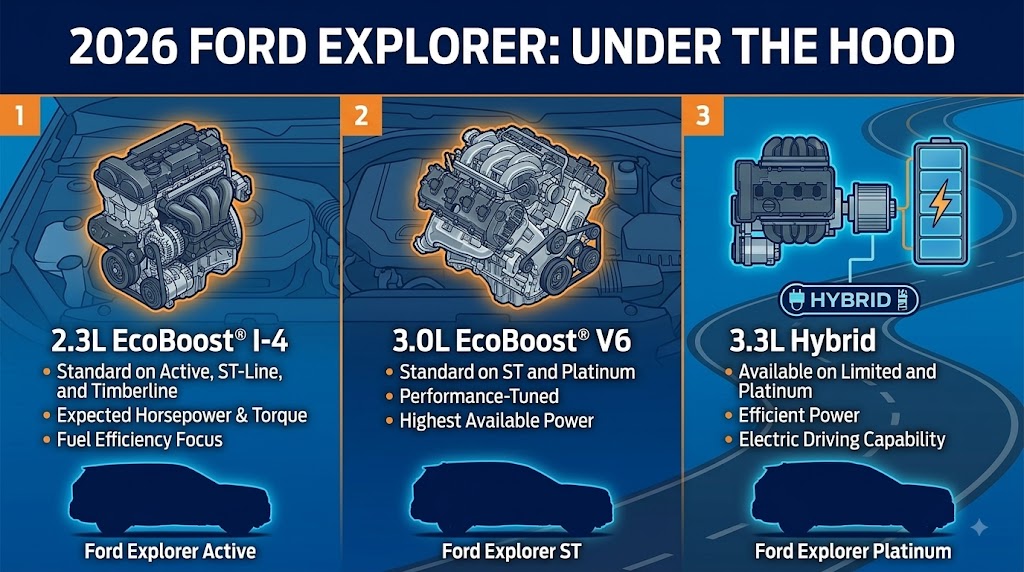
The base 2.3-liter EcoBoost engine produces 300 horsepower and 310 lb-ft of torque, providing an excellent mix of power and fuel economy. It is standard on the Active 100A, Active, ST-Line, Tremor (base configuration), and Platinum trims, paired with the 10-speed automatic transmission and available in either rear-wheel drive (RWD) or Intelligent 4WD.
In real-world driving, this engine is more than adequate for the vast majority of Explorer use cases. Highway merging, suburban acceleration, and towing loads below 4,000 pounds are all handled with confidence. EPA fuel economy figures for the 2.3-liter EcoBoost in RWD configuration are rated at approximately 21 city / 28 highway mpg, with 4WD configurations returning slightly lower figures. These are competitive efficiency ratings for a three-row midsize SUV producing 300 horsepower.
The 2.3-liter’s power delivery is linear and responsive throughout the rev range, with the turbocharger spooling quickly enough to avoid the lag that characterized earlier EcoBoost applications. For most family buyers who prioritize cargo capacity, passenger space, and towing over maximum performance, the 2.3-liter EcoBoost is the correct powertrain choice.
3.0-Liter Twin-Turbo EcoBoost V6 — ST and Available on Tremor
For those looking for even more power, the 3.0-liter EcoBoost V6 makes 400 horsepower and 415 lb-ft of torque. Both engines pair with the advanced 10-speed automatic transmission. The 3.0-liter V6 transforms the driving experience — throttle response feels immediate and the additional torque makes the Explorer feel significantly more effortless in everyday driving.
Independent testing by Car and Driver describes the twin-turbo V6 as one of their favorite engines in the three-row SUV class — a description echoed by KBB reviewers, who call it simply one of the best engine choices in the segment. In the Explorer ST, this engine enables a genuinely performance-oriented driving character that no family three-row competitor can match. The Explorer Tremor becomes the first non-ST Explorer that can be optioned with the 400-hp twin-turbo V6 — a significant development for buyers who want adventure-ready capability alongside maximum power.
EPA fuel economy for the 3.0-liter EcoBoost is rated at approximately 18 city / 24 highway mpg in the ST configuration with 4WD — acceptable for a 400-horsepower three-row SUV but not a powertrain choice for buyers who prioritize fuel costs above performance.
Engine Comparison at a Glance:
| Configuration | Horsepower | Torque | Available On |
|---|---|---|---|
| 2.3L EcoBoost I-4 | 300 hp | 310 lb-ft | Active, ST-Line, Tremor, Platinum |
| 3.0L EcoBoost V6 | 400 hp | 415 lb-ft | ST, Tremor (optional) |
2026 Ford Explorer Towing Capacity: Family and Adventure Hauling
When properly equipped with the standard Class III Trailer Tow Package, the 2026 Ford Explorer can tow up to 5,000 pounds across all trim levels. This tow rating is consistent across both the 2.3-liter and 3.0-liter engine options, meaning buyers do not need to step up to the larger engine solely for towing capability. The Class III Tow Package is standard on the Active trim and most configurations above it.
The 5,000-pound rating is competitive with the Kia Telluride’s standard capacity (also 5,000 pounds) and the Toyota Highlander’s maximum rating, though it falls short of the Telluride X-Pro’s 5,500-pound ceiling. For most family towing use cases — a mid-sized camping trailer, a ski boat, a loaded cargo trailer, or personal watercraft — 5,000 pounds covers the need decisively.
The Terrain Management System available across most 2026 Explorer trims includes a dedicated Tow/Haul drive mode that adjusts shift points and throttle calibration specifically for trailering conditions. When towing with the Tremor trim, the Torsen limited-slip rear differential adds stability under load on grades and in adverse weather. The 3.0-liter V6 in the Tremor produces enough torque to make highway grades and merges feel almost effortless when pulling a loaded trailer — genuinely impressive for a unibody crossover-platform SUV.
2026 Ford Explorer Driving Dynamics: RWD Platform and Terrain Management
The 2026 Ford Explorer’s rear-wheel-drive platform is its most fundamentally distinctive feature in the three-row midsize SUV segment. Where virtually every competitor uses a front-wheel-drive-biased crossover architecture, the Explorer’s RWD foundation delivers a steering feel, weight distribution, and handling balance that serious drivers notice immediately on a first test drive.
Kelley Blue Book reviewers note that even when equipped with all-wheel drive, the rear-wheel-drive bias is noticeable and welcome, lending a decidedly sporty driving experience to what is otherwise a practical family hauler. The Explorer does not try to pretend it is something it is not — it is a genuinely driver-oriented three-row SUV, and the RWD platform is the foundation of that identity.
The Terrain Management System features up to seven selectable drive modes — Normal, Eco, Sport, Tow/Haul, Slippery, Trail, and Deep Snow/Sand — to adjust shift points and traction control parameters. Side-Wind Stabilization is a standard software feature that applies individual wheel braking to counteract crosswind push during highway driving — a meaningful safety benefit for drivers in open plains states where lateral wind gusts can affect large vehicles.
The Explorer ST’s performance package elevates the driving experience further with sport-tuned steering, stiffer suspension calibration, and the full 400-hp V6 delivering sub-seven-second 0-60 mph acceleration. Autoblog describes the ST as offering “genuinely thrilling” performance for a three-row family SUV — a category descriptor that typically involves more modest claims.
2026 Ford Explorer Interior: Digital Experience and Three-Row Practicality
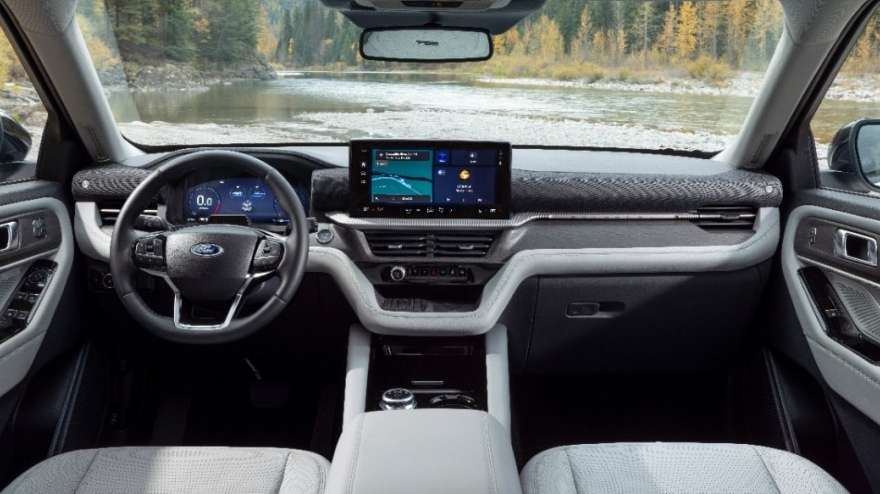
Ford Digital Experience and 13.2-Inch Touchscreen
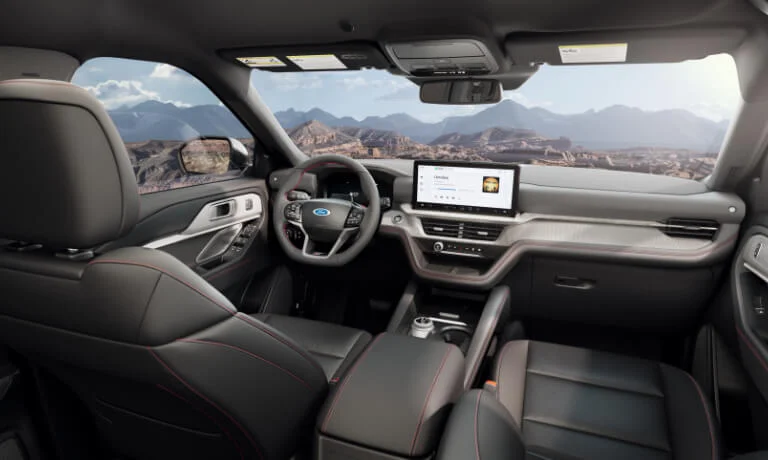
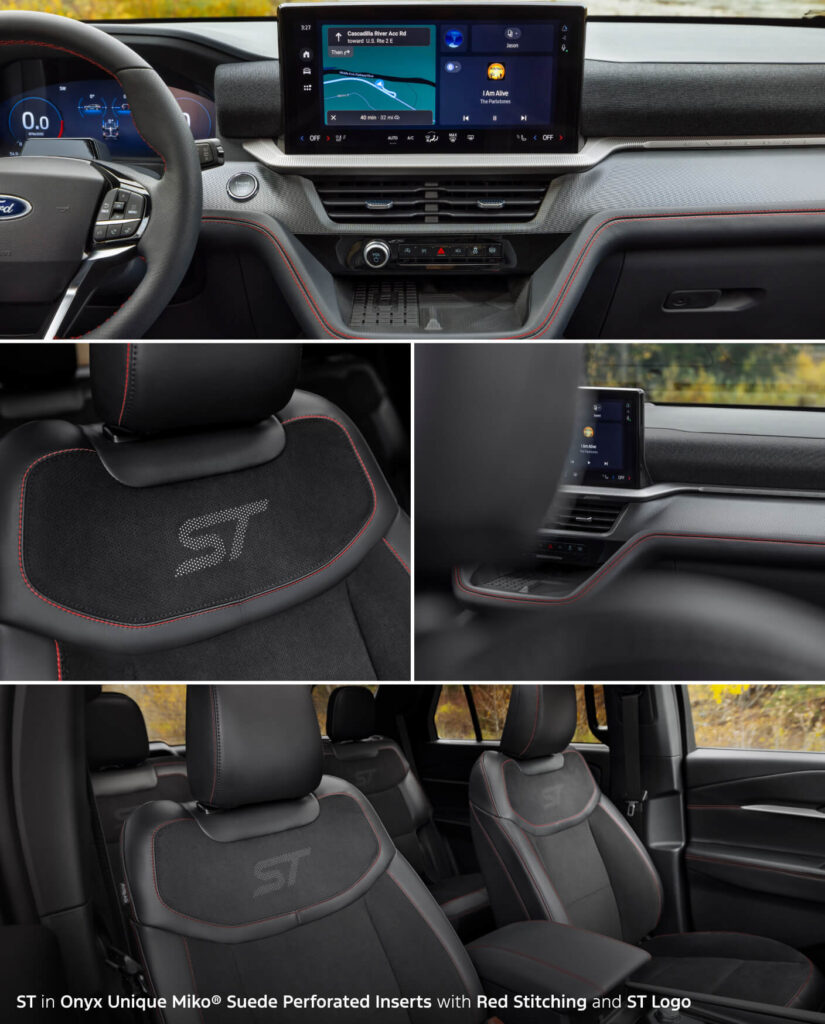
All 2026 Explorer models come with a 13.2-inch center display as standard equipment, alongside a fully digital gauge cluster with sharp graphics that cycles through available drive modes via a center console dial. The Ford Digital Experience software platform integrates Google Maps, Google Play Store access, and Google Assistant as native applications — not smartphone mirroring but actual built-in Google services that operate independently of a connected phone. Apple CarPlay and Android Auto are also supported wirelessly.
When the vehicle is parked, the system supports video streaming from YouTube, internet browsing, and gaming via Google Play, making the Explorer’s infotainment system one of the most broadly capable in the three-row midsize SUV category for families who spend time waiting during athletic events, road trip stops, or school pickups.
Available BlueCruise hands-free driver assistance, in its version 1.5 iteration available on upper trims and as part of option packages, provides hands-free highway driving with automatic lane-change functionality — a feature level that genuinely competes with GM’s Super Cruise and is not available from most mainstream three-row SUV competitors. BlueCruise eases the fatigue of long highway driving in a larger vehicle like the Explorer, particularly on road trips where lane centering on highways with variable-quality pavement would otherwise require sustained attention.
Passenger and Cargo Space
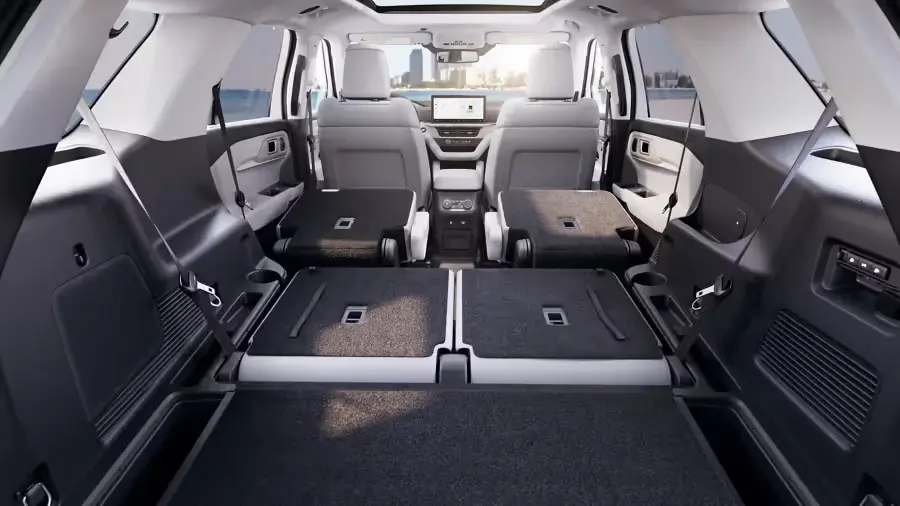
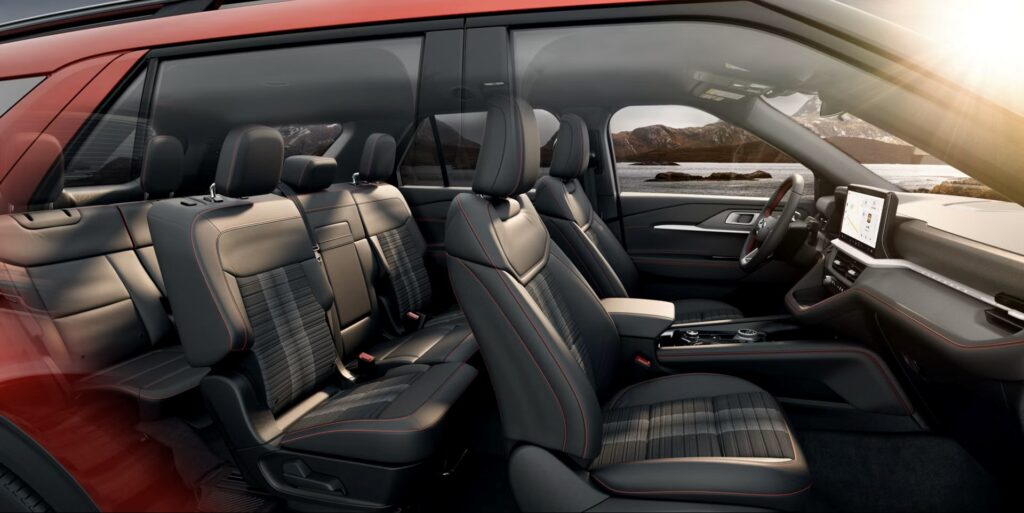
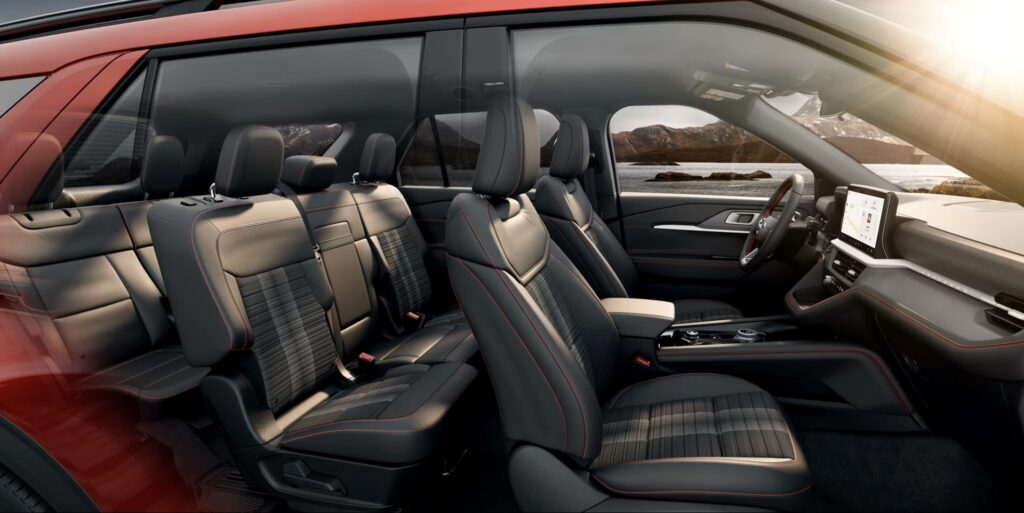
The 2026 Ford Explorer seats up to seven passengers across three rows with standard bench seating, or six with optional second-row captain’s chairs. Total maximum cargo volume reaches 87.8 cubic feet with all rear seats folded flat — among the largest in the three-row midsize SUV class and a meaningful advantage over rivals like the Mazda CX-50 (74.4 cubic feet) and even the Kia Telluride.
The third row of the 2026 Ford Explorer is the vehicle’s one consistent limitation in passenger reviews. While the Kia Telluride’s third row comfortably accommodates adults, the Explorer’s third row is more suited to children or adults on short trips. Ford offers PowerFold third-row seats that fold flat with a button press, making cargo mode conversion fast and easy — a practical feature for families who regularly switch between passenger and cargo configurations.
E-Z Entry second-row captain’s seats and PowerFold third-row seats make loading and unloading people or cargo straightforward in the 2026 Explorer. The rear cargo area opens to a wide, practical space with a low load floor that makes loading heavy items achievable without excessive lifting.
Interior Quality Assessment
Interior quality in the 2026 Ford Explorer varies more noticeably across the trim range than in some rivals. The base Active 100A and Active trims use materials that are honest and durable but do not project a premium feel — a trade-off that Ford made deliberately to maintain price accessibility at the entry level. Ford added a new Active 100A base trim that lowers the Explorer’s price, though it achieves that by removing features like the power liftgate and heated seats, which may be a deal-breaker for buyers in northern states.
From the ST-Line upward, interior quality improves meaningfully. The Tremor’s interior includes contrast stitching, handsome trim on the dash and doors, and the Explorer’s name in the front seatbacks, creating a specific character that feels purposeful rather than decorative. The Platinum trim delivers the most premium cabin experience in the Explorer lineup, with softer leather seating surfaces and a more thoroughly finished dashboard.
2026 Ford Explorer Safety: Standard Equipment and BlueCruise
Every 2026 Ford Explorer is equipped with Ford’s standard active safety suite, including:
- Pre-Collision Assist with Automatic Emergency Braking and pedestrian detection
- Forward Collision Warning
- Blind-Spot Information System
- Lane-Keeping System
- Rear View Camera with dynamic guidelines
- Cross-Traffic Alert
- AdvanceTrac with Roll Stability Control
- Safety Canopy side-curtain airbags for all three rows
- Driver Knee Airbag
- SOS Post-Crash Alert System
The Tremor trim includes a 360-degree camera system as standard, along with a 5G modem, Wi-Fi hotspot capability, and the full Ford Digital Experience platform. Upper trims and option packages add Reverse Brake Assist, Evasive Steering Assist, Active Park Assist 2.0 for automated parking in both parallel and perpendicular spaces, and the available BlueCruise 1.5 hands-free highway driving system.
The NHTSA has assigned the 2026 Ford Explorer a five-star overall safety rating, maintaining the vehicle’s long-standing position as one of the safer three-row midsize SUVs in the segment. Ford’s Safety Canopy side-curtain airbag system extends full-length coverage across all three seating rows — meaningful protection for a seven-passenger vehicle where rear occupants sit considerably further from traditional airbag coverage zones.
2026 Ford Explorer Trim Levels and Pricing: Complete Breakdown
The 2026 Explorer is available in six trims — Active 100A, Active, ST-Line, ST, Platinum, and Tremor — with starting prices ranging from $38,465 to $56,905 before options. All prices below are base MSRP before destination charges.
Active 100A — From $38,465 (RWD)
The new Active 100A is the most affordable entry point into the 2026 Ford Explorer lineup, created by removing the power liftgate and heated seats from the standard Active. It is the correct trim for buyers in warmer climates who prioritize value over convenience features, and for fleet or commercial buyers who need basic three-row capacity at the lowest possible price. The 13.2-inch touchscreen, Ford Digital Experience, and the full driver assistance suite remain standard even here.
Active — From $44,145 (RWD) / $47,845 (4WD)
The Active lists at around $40,000 with two-wheel drive and $44,000 for 4WD — the trim that U.S. News identifies as one of the best value choices in the Explorer lineup for providing a wide array of standard and available features at an accessible price. The Active adds a power liftgate, heated front seats, the Class III Trailer Tow Package, and remote start over the 100A. Kelley Blue Book Fair Purchase Pricing indicates buyers are regularly achieving $1,960 to $4,200 below MSRP on Explorer trims, making real-transaction prices on the Active particularly competitive.
ST-Line — From $48,715 (4WD)
The ST-Line balances sporty features with affordability, offering the 300-hp turbo four-cylinder engine as a great option for buyers who want a sporty feel without the high price of the full ST. The ST-Line adds a sport-tuned appearance package — unique wheels, blacked-out exterior trim, ST-Line badging, and sport-enhanced cabin styling — to the Active’s practical feature content. Intelligent 4WD is standard on the ST-Line. It is the trim most analogous to the sport-appearance packages offered by rivals like the Kia Telluride X-Line without the additional off-road hardware.
Tremor — From $50,025 (4WD Standard)
The Tremor answers a question many Explorer buyers have been asking for years: what if the Explorer ST wasn’t the only enthusiast-focused variant? With its Torsen limited-slip rear differential, off-road-tuned suspension, 18-inch alloy wheels wearing Goodyear all-terrain tires, front and rear steel skid plates, and approximately one additional inch of ground clearance, the Tremor is a purpose-built trail-capable version of America’s most storied three-row SUV — not a graphics package.
Standard Tremor equipment includes the power liftgate, Class III Trailer Tow Package, remote start, 360-degree camera system, Wi-Fi hotspot, 5G modem, USB-C ports in all three rows, power passenger seat, first and second-row floor liners, a 110-volt outlet, selectable drive modes, and the Bang and Olufsen 10-speaker audio system.
The available Ultimate Package at $11,850 adds the 400-hp 3.0-liter V6, a 14-speaker B&O audio system, a panoramic roof, massaging front seats, and BlueCruise — creating the most fully featured adventure-oriented Explorer ever built. Outside of the Platinum’s posher leather seats, there is not much missing from a fully loaded Tremor compared to the top-spec Platinum.
Platinum — From $54,525 (4WD Standard)
The Platinum is the luxury anchor of the 2026 Ford Explorer lineup, featuring the most premium interior materials in the family — soft leather across all seating surfaces, ambient interior lighting, the highest-specification comfort features, and a comprehensive standard technology package. The Platinum targets buyers who want the Explorer’s distinctive RWD platform character and genuine three-row capacity presented in a genuinely upscale environment. At $54,525, it competes directly with the Lincoln Aviator’s base configuration at a notably lower price point.
ST — From $58,465 (4WD Standard)
The Explorer ST is the performance flagship. At $58,465 with the 3.0-liter V6’s 400 horsepower and 415 lb-ft of torque as standard, the ST delivers 0-60 mph acceleration in well under seven seconds from a three-row family SUV — a specification that has no direct peer in the mainstream segment. The ST adds sport-tuned suspension, unique 21-inch wheels, red brake calipers, ST-specific exterior styling, and a sport-biased interior with performance seats. At a price that gets close to the Lincoln Aviator, the ST offers genuinely competitive performance if not quite the same interior polish as Ford’s own luxury brand sibling.
2026 Ford Explorer vs. Rivals: Competitive Positioning
The 2026 Ford Explorer’s competitive position is strongest against buyers who specifically value the RWD-biased driving platform, strong engine choices, and the new Tremor’s off-road credentials.
Against the Kia Telluride, the Explorer’s base engine outpowers the Telluride’s V6 (300 hp versus 291 hp), the Explorer ST massively exceeds the Telluride’s performance ceiling (400 hp versus 291 hp), and maximum cargo volume (87.8 cubic feet) exceeds the Telluride’s (87.0 cubic feet).
The Telluride counters with a more generous standard feature set at each price point, superior third-row adult comfort, and the industry-leading 10-Year/100,000-Mile powertrain warranty versus the Explorer’s 3-Year/36,000-Mile basic and 5-Year/60,000-Mile powertrain coverage. Against the Toyota Highlander, the Explorer’s powertrain options are dramatically stronger, though the Highlander Hybrid’s 36 mpg combined is a significant efficiency advantage. Against the Honda Pilot, the Explorer’s driving dynamics are meaningfully more engaging, and the Tremor has no direct Pilot equivalent.
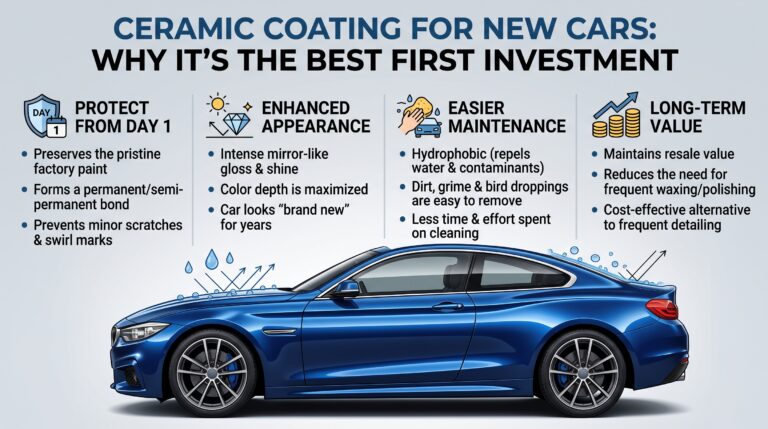
For Explorer owners who have made the investment in this distinctive RWD platform SUV, protecting the vehicle’s paint finish from the environmental hazards that accompany an active ownership lifestyle is a worthwhile priority from day one. Red’s Detail Co., Atlanta’s trusted professional auto detail center, provides ceramic coatings and paint protection film services specifically designed for family SUVs that encounter everything from summer UV exposure and road salt to camping debris and towing dust.
Their comprehensive comparison of paint protection film versus ceramic coating helps Explorer owners identify which protection solution best fits their vehicle’s use case. Visit redsdetailco.com to explore options that keep the Explorer’s distinctive exterior looking its best through years of family driving.
Who Should Buy the 2026 Ford Explorer?
The 2026 Ford Explorer speaks most directly to buyers for whom driving character matters alongside three-row practicality — a buyer profile the Kia Telluride and Honda Pilot do not serve as completely.
Performance-minded family buyers who want the strongest powertrain available in a mainstream three-row SUV should configure the Explorer ST. No competitor offers 400 horsepower at this price point with three-row seating. The ST’s combination of genuine performance, daily usability, and family capacity is unique in the segment.
Adventure and off-road families who want trail capability, genuine hardware rather than a visual package, and the option to add 400-horsepower performance should configure the Tremor. As the first non-ST Explorer to offer the 3.0-liter V6 alongside actual off-road hardware, the Tremor represents the most capable configuration in the Explorer’s history.
Value-focused families who want a well-equipped three-row SUV with an engaging driving character at a price below $50,000 should configure the Active or ST-Line. Both deliver the Explorer’s RWD platform benefits, the 300-hp EcoBoost, and the Ford Digital Experience with Google integration at prices where the Kia Telluride and Honda Pilot are strong alternatives but where the Explorer’s driving differentiation still justifies consideration.
Technology and luxury buyers who want premium materials, BlueCruise hands-free driving, massaging seats, and a panoramic roof in a three-row SUV should configure the Platinum or a loaded Tremor Ultimate Package. Both compete with entry-level luxury three-row alternatives at prices that remain below the Lincoln Aviator’s starting point.
Honest Pros and Cons of the 2026 Ford Explorer
Compelling Strengths:
The 2026 Ford Explorer’s rear-wheel-drive-biased platform delivers a driving character unique in the three-row midsize SUV class — more engaging, more sporty, and more rewarding for drivers who actually enjoy the act of driving their family SUV. The 400-horsepower twin-turbo V6 in the ST and available Tremor configurations is genuinely exceptional — one of the best engine options in any mainstream midsize SUV.
The new Tremor trim brings real off-road hardware to a capable body: Torsen limited-slip differential, all-terrain tires, skid plates, and a tuned suspension. Maximum cargo volume of 87.8 cubic feet leads the segment. Google Built-in on the 13.2-inch touchscreen delivers native application access that wired CarPlay and Android Auto cannot replicate. BlueCruise hands-free driving on upper configurations provides hands-off highway cruising capability not available from most mainstream rivals.
Real Limitations Worth Acknowledging:
The third-row legroom in the 2026 Ford Explorer is the most consistently cited limitation in independent reviews — adults in the third row will find it noticeably tighter than the Kia Telluride’s best-in-class rear accommodation. Interior materials on the Active and Active 100A trims read as utilitarian rather than premium, requiring a step to the ST-Line or above for a cabin that matches the Explorer’s exterior presence and driving character.
The 3-Year/36,000-Mile basic warranty is significantly shorter than the Kia Telluride and Hyundai Palisade’s 5-Year/60,000-Mile basic coverage and far shorter than the Kia’s 10-Year/100,000-Mile powertrain protection. The 10-speed automatic at city speeds can exhibit notchy shifting in certain conditions, particularly with the more powerful V6 under light loads. No hybrid powertrain is available for the 2026 Explorer — buyers who prioritize fuel efficiency should evaluate the Toyota Highlander Hybrid.
Frequently Asked Questions About the 2026 Ford Explorer
Is the 2026 Ford Explorer rear-wheel drive or front-wheel drive?
The 2026 Ford Explorer uses a rear-wheel-drive-biased platform — a significant distinction from the front-wheel-drive-based crossovers that dominate the three-row midsize SUV class. Intelligent 4WD with Terrain Management is available across all trims and standard on the ST-Line, Tremor, Platinum, and ST configurations.
What engines does the 2026 Ford Explorer offer?
The 2026 Ford Explorer offers two EcoBoost engine options. The base engine is a 2.3-liter turbocharged four-cylinder producing 300 horsepower and 310 lb-ft of torque, standard on all trims except the ST. The performance engine is a 3.0-liter twin-turbocharged V6 producing 400 horsepower and 415 lb-ft of torque, standard on the ST and available as an option on the Tremor.
How much can the 2026 Ford Explorer tow?
When properly equipped with the Class III Trailer Tow Package, the 2026 Ford Explorer can tow up to 5,000 pounds across all trim levels, regardless of whether the 2.3-liter or 3.0-liter engine is fitted. The Tow/Haul drive mode in the Terrain Management System optimizes shift points and throttle calibration specifically for trailering conditions.
What is the starting price of the 2026 Ford Explorer?
The 2026 Ford Explorer starts at $38,465 for the new Active 100A trim, with the range-topping ST beginning at $56,905 before options and destination charges. Kelley Blue Book Fair Purchase Pricing indicates buyers are typically achieving $1,960 to $4,200 below MSRP depending on trim, market, and available incentives.
What is new for the 2026 Ford Explorer?
The most significant addition for the 2026 Ford Explorer is the all-new Tremor trim, which replaces the Timberline as the adventure-capable Explorer variant. The Tremor comes with an extra inch of ground clearance, all-terrain tires, steel underbody protection, a Torsen limited-slip differential, and is the first non-ST Explorer to offer the 400-hp twin-turbo V6 as an option. A new lower-priced Active 100A trim also joins the lineup for 2026.
Does the 2026 Ford Explorer have BlueCruise?
Yes. BlueCruise hands-free highway driving is available on upper Explorer trims and as part of the Tremor’s Ultimate Package. Version 1.5 of BlueCruise introduces automatic lane-change functionality, which activates to pass slower vehicles with driver intent signaled through the turn indicator.
What are the cargo dimensions of the 2026 Ford Explorer?
The 2026 Ford Explorer provides 87.8 cubic feet of maximum cargo volume with all rear seats folded flat, making it one of the most spacious vehicles in the three-row midsize SUV segment for total cargo carrying ability.
Final Verdict: The Performance Choice in a Three-Row Segment Defined by Practicality
The 2026 Ford Explorer does not win buyers by offering the most generous third-row legroom or the longest warranty coverage in the three-row midsize SUV class. It wins them by being the only vehicle in this segment that delivers a genuinely sporting driving character, two legitimately impressive EcoBoost engine options, and — with the new Tremor — a purpose-built off-road variant that carries real hardware rather than stylistic suggestions of capability.
The Explorer ST’s 400-horsepower twin-turbo V6 remains one of the most exciting engines available in any mainstream family SUV at any price. The Tremor’s combination of off-road hardware and optional V6 performance is unprecedented in the Explorer family. The RWD-biased platform’s contribution to driving character is real, noticeable, and valued by every driver who has spent time in both the Explorer and its crossover-platform rivals.
For buyers who want space, technology, and towing capability alongside a driving experience that rewards engagement rather than merely tolerating it — the 2026 Ford Explorer remains the most compelling choice in the three-row midsize segment.
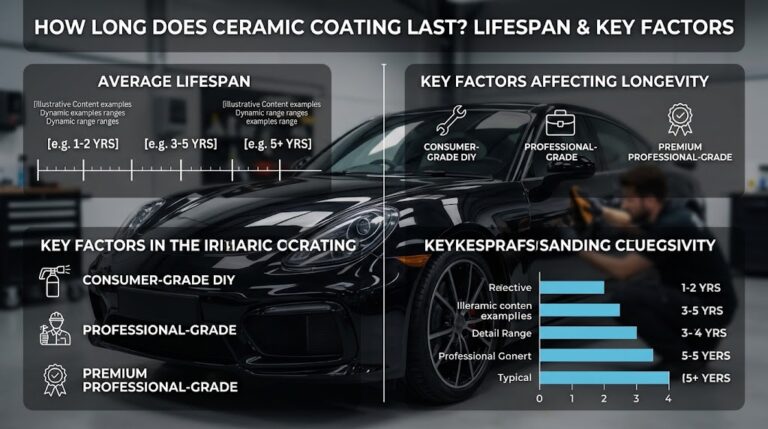
Explorer owners who want to protect their vehicle’s distinctive exterior against UV damage, road salt, bird droppings, and trail debris should consider professional ceramic coating from day one of ownership. Red’s Detail Co. in Atlanta specializes in ceramic coatings and paint protection film for active-lifestyle family SUVs like the Explorer, with services tailored to each vehicle’s specific use case and regional climate. Visit redsdetailco.com to learn how their team can protect your Explorer’s finish for the long term.
Related Content:
- 2026 Ford Explorer Tremor vs. 2026 Kia Telluride X-Pro: Off-Road Three-Row SUV Showdown
- 2026 Ford Explorer ST vs. Lincoln Aviator: Is the Family Performance Upgrade Worth the Price?
- Best Three-Row SUVs for Towing in 2026: Ranked by Capacity and Capability
- How to Protect Your SUV’s Paint with Ceramic Coating vs. PPF
All pricing reflects MSRP as published by Ford and verified against current third-party market data. Destination charges of $1,695 are excluded from base MSRP figures unless otherwise noted. EPA fuel economy figures are estimates; real-world results will vary. Horsepower figures reflect standard fuel ratings; premium fuel may affect output on certain configurations. Towing requires proper trailer tow equipment; consult owner documentation for configuration-specific ratings. Warranty terms are effective as of the 2026 model year.