Paint Correction Explained: 2026 The Complete Guide to Choosing the Right Paint Correction Service
Introduction
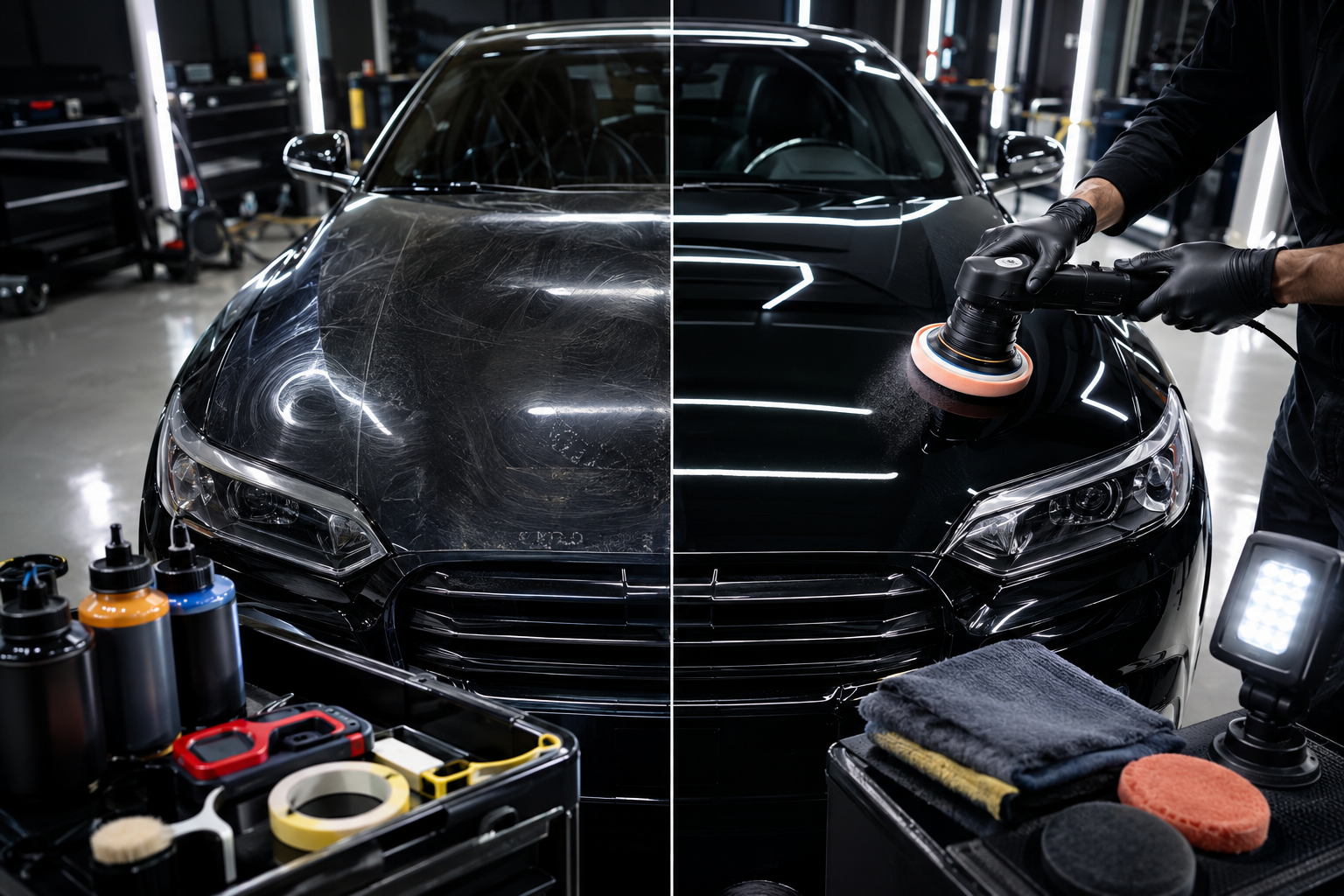
Paint Correction Explained: Every car owner eventually notices it — under bright sunlight or direct halogen light, the paint that once looked flawless is covered in fine swirl marks, spider-webbing, water spots, and dull patches. This is where paint correction comes in. Unlike a simple wash or wax, paint correction is a multi-step process that removes surface imperfections from your clear coat to restore true gloss and depth.
A professional paint correction service goes far beyond a typical detail. It uses machine polishers, cutting compounds, and finishing polishes in a carefully controlled sequence to level out microscopic damage in the clear coat without removing more material than necessary. The result is a finish that often looks better than it did the day the car left the factory.
In this guide, we’ll cover everything you need to know about paint correction: why it matters, the different levels and types available, how maintenance compares across each, the pros and cons of each approach, repair tips, cleaning routines, common mistakes to avoid, and answers to the most frequently asked questions. Whether you’re considering DIY correction or hiring a professional paint correction service, this article will help you understand exactly what you’re getting into.
Why Paint Correction Matters
Every time your car goes through an automatic car wash, gets wiped down with a dirty towel, or sits under the sun for years, its clear coat accumulates thousands of microscopic scratches. Individually, these are invisible. Collectively, they scatter light instead of reflecting it cleanly, which is what creates that hazy, dull look even on a freshly washed car.
Paint correction matters for several concrete reasons:
- Restores true gloss and clarity – Removing swirl marks and light scratches allows light to reflect evenly, restoring the paint’s original depth and shine.
- Increases resale and trade-in value – A corrected, swirl-free finish signals a well-maintained vehicle and can meaningfully boost appraisal value.
- Prepares the surface for protection – Ceramic coatings and paint protection film bond and look best on a properly corrected surface; applying them over swirls locks in those imperfections permanently.
- Removes water spots and oxidation – Correction can eliminate mineral deposits and light oxidation that washing alone cannot touch.
- Extends the life of your paint – By addressing damage early, you reduce the risk of it progressing into the base coat, which would require far more expensive repainting.
Simply put, paint correction is the foundation of a truly show-quality finish, and it’s a critical step that many car owners skip — often to their long-term regret.
Different Types of Paint Correction (10+ Types)
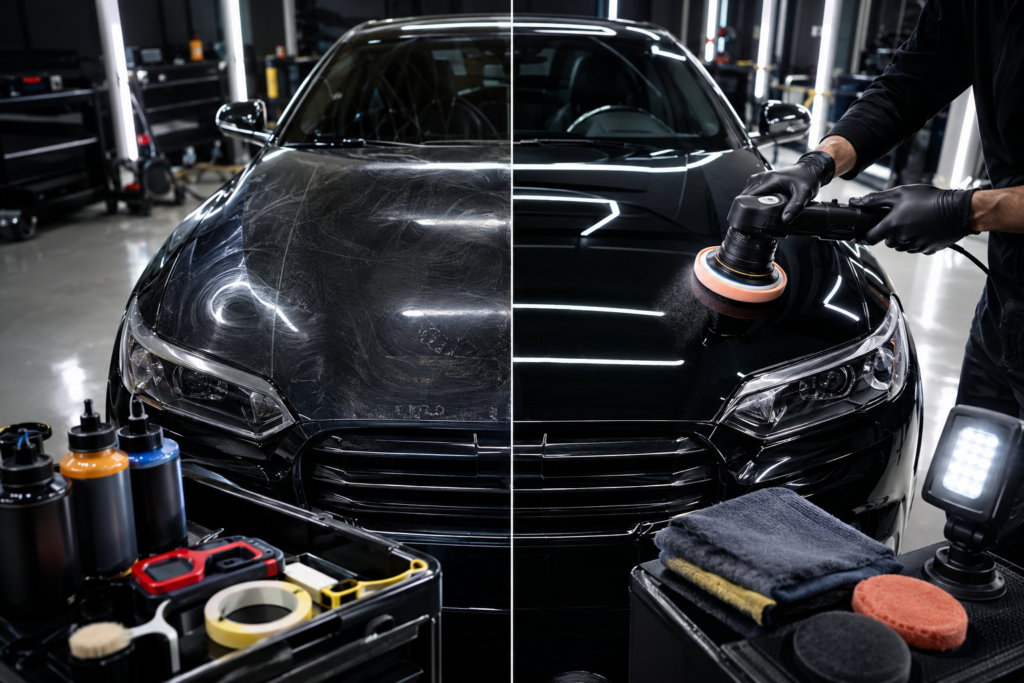
Paint correction isn’t a single, one-size-fits-all process. Depending on the paint’s condition and the desired outcome, a paint correction service may offer several tiers or techniques. Here are the main types you’ll encounter.
- One-Step Paint Correction – A single polishing pass designed to remove light swirl marks and add gloss without heavy cutting. Ideal for newer or well-maintained cars.
- Two-Step Paint Correction – Combines a cutting/compounding stage with a finishing polish stage to remove moderate swirls, light scratches, and oxidation.
- Three-Step (Multi-Stage) Paint Correction – Involves compounding, polishing, and finishing passes for heavily damaged or neglected paint with deep swirls and scratches.
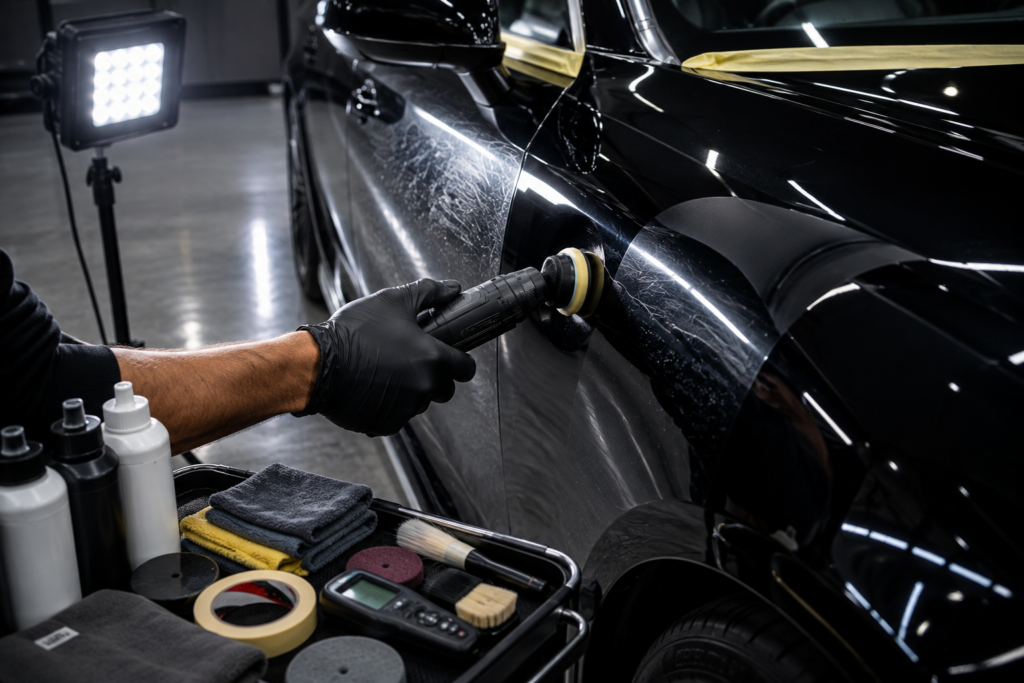
- Machine Polishing (Dual-Action) – Uses a dual-action random orbital polisher, which is safer for beginners and reduces the risk of burning through clear coat.
- Rotary Polishing – Uses a high-speed rotary buffer for more aggressive correction; faster but requires skill to avoid heat damage or holograms.
- Wet Sanding Correction – Involves ultra-fine sandpaper to level severe imperfections like deep orange peel or heavy oxidation before polishing; typically reserved for advanced cases.
- Spot Paint Correction – Targets isolated problem areas, such as a single panel with heavy swirling, rather than the entire vehicle.
- Full Vehicle Paint Correction – A comprehensive correction covering every exterior panel for an even, uniform finish.
- Single-Stage Paint Correction (for older vehicles) – Designed for cars without a clear coat layer, requiring different compounds and techniques than clear-coated finishes.
- Paint Correction for Matte or Satin Finishes – Uses specialized matte-safe products since traditional polishing compounds can create unwanted gloss on matte paint.
- Ceramic-Ready Paint Correction – A precision-level correction performed specifically to prep the surface for ceramic coating or PPF application.
- Show-Car / Competition-Level Correction – An extremely meticulous, multi-stage process aimed at eliminating virtually all visible imperfections, often used for concours or show vehicles.
A reputable paint correction service will typically assess your paint condition first and recommend the appropriate tier rather than applying a blanket approach to every vehicle.
Maintenance Comparison
The type of paint correction performed affects how much upkeep is needed afterward to preserve the results. Here’s a general comparison:
| Type | Correction Level | Maintenance Frequency | Longevity of Results |
|---|---|---|---|
| One-Step Correction | Light | Moderate (every wash matters) | 3–6 months without protection |
| Two-Step Correction | Moderate | Moderate | 6–12 months |
| Three-Step Correction | Heavy | Low-Moderate (with protection) | 1–2 years |
| Machine Polishing (DA) | Light-Moderate | Moderate | 6–12 months |
| Rotary Polishing | Moderate-Heavy | Low-Moderate | 1–2 years |
| Wet Sanding Correction | Severe | Low (with follow-up protection) | 2+ years |
| Spot Correction | Localized | High (isolated area needs monitoring) | Varies by panel |
| Full Vehicle Correction | Comprehensive | Low (with proper coating) | 1–3 years |
| Ceramic-Ready Correction | Precision | Very Low (paired with coating) | 2–5 years |
As a general rule, more thorough correction paired with a protective coating afterward requires the least ongoing maintenance and preserves results the longest.
Maintenance Explained
Paint correction results aren’t permanent on their own — the same environmental factors that caused the original swirls and scratches will begin to reintroduce them unless you follow a proper maintenance routine. Here’s what that involves:
- Applying protection immediately after correction, such as a wax, sealant, or ceramic coating, to lock in the corrected finish and slow down new damage.
- Using the two-bucket wash method with a clean, soft microfiber wash mitt to avoid reintroducing swirl marks.
- Drying with a clean microfiber towel or air dryer rather than an old rag, which is one of the most common causes of new swirls.
- Avoiding automatic car washes with abrasive brushes, which can undo months of correction work in a single wash.
- Periodic maintenance detailing every few months to check for new contamination, light scratching, or fading of the applied protection layer.
Vehicles that receive a full paint correction paired with a ceramic coating typically require the least frequent maintenance, since the coating acts as a sacrificial barrier that absorbs the minor abrasion from washing.
Pros & Cons of Each Type
One-Step Correction
- Pros: Affordable, fast, good for lightly swirled paint
- Cons: Doesn’t address deeper scratches or heavy oxidation
Two-Step Correction
- Pros: Balanced result for most daily-driven cars
- Cons: More time and cost than a single-step polish
Three-Step Correction
- Pros: Removes deep swirls and significant imperfections
- Cons: Most expensive and time-consuming; removes more clear coat material
Dual-Action Machine Polishing
- Pros: Beginner-friendly, lower risk of burning paint
- Cons: Slower and less aggressive than rotary methods
Rotary Polishing
- Pros: Faster, more effective on severe defects
- Cons: Higher risk of holograms or heat damage if done incorrectly
Wet Sanding Correction
- Pros: Can fix severe imperfections other methods can’t touch
- Cons: Requires expert skill; removes the most clear coat material
Spot Correction
- Pros: Cost-effective for isolated problem areas
- Cons: May create an uneven finish compared to surrounding panels
Full Vehicle Correction
- Pros: Uniform, consistent results across the entire car
- Cons: Higher cost and longer service time
Ceramic-Ready Correction
- Pros: Maximizes the performance and appearance of a subsequent coating
- Cons: Typically priced at a premium due to precision requirements
Repair Tips for Each Type
- One-Step Correction: Light swirl marks that reappear can often be maintained with a quick spray polish between full corrections.
- Two-Step Correction: If moderate scratches return, a maintenance polish every 6–12 months helps avoid needing a full recorrection.
- Three-Step Correction: Follow up with a ceramic coating to protect the significant clear coat investment already made.
- Dual-Action Machine Polishing: Re-polish trouble spots with finer pads and polish rather than repeating the full process.
- Rotary Polishing: Have a professional inspect for holograms; these require a finishing pass with a foam pad, not a full recorrection.
- Wet Sanding Correction: Any future deep defects should be evaluated by a professional to check remaining clear coat thickness before resanding.
- Spot Correction: Blend adjacent panels during touch-ups to maintain a consistent look.
- Full Vehicle Correction: Schedule annual inspections to catch new swirling early before it requires another full correction.
- Ceramic-Ready Correction: Any coating damage should be addressed by reapplying a booster rather than re-correcting the paint underneath.
Cleaning & Maintenance Best Practices
To protect your paint correction investment, follow these best practices:
- Wash weekly using the two-bucket method to minimize the introduction of new swirl marks.
- Use a pH-neutral car shampoo designed for coated or corrected paint.
- Dry with a plush microfiber towel or a touchless air dryer to avoid friction-based scratching.
- Avoid brush-based automatic car washes, which are a leading cause of new swirl marks.
- Apply a spray wax or sealant every few weeks if no ceramic coating is present.
- Park away from direct sun and tree sap whenever possible to minimize environmental damage.
- Address bird droppings and bug splatter quickly, as these can etch into freshly corrected paint if left too long.
Common Mistakes to Avoid
- Skipping paint correction before applying protection – Sealing in swirl marks with wax or ceramic coating makes them permanent until the next correction.
- Choosing the cheapest paint correction service without research – Inexperienced technicians can remove too much clear coat or leave holograms.
- Washing with dirty or low-quality towels – This reintroduces the same swirl marks that were just removed.
- Expecting permanent results without protection – Without a wax, sealant, or ceramic coating, corrected paint is vulnerable to fast re-scratching.
- Over-correcting thin or previously repainted panels – Aggressive correction on thin clear coat can burn through to the base coat.
- Ignoring panel thickness readings – A reputable service should measure clear coat thickness before deciding how aggressive to be.
- Neglecting regular maintenance washes – Even a perfect correction degrades faster without a consistent care routine afterward.
Frequently Asked Questions (FAQs)
1. What is paint correction? Paint correction is a process that uses machine polishing and compounds to remove swirl marks, scratches, and oxidation from a vehicle’s clear coat, restoring gloss and clarity.
2. How much does a paint correction service typically cost? Costs vary based on vehicle size and correction level, generally ranging from a couple hundred dollars for a one-step polish to over a thousand for multi-stage correction.
3. How long does paint correction take? A one-step correction may take a few hours, while a full multi-stage correction on a larger vehicle can take a full day or more.
4. Does paint correction remove clear coat? Yes, it removes a microscopically thin layer of clear coat to level out imperfections, which is why it should only be done when necessary and by a skilled technician.
5. Can paint correction fix deep scratches? Only if the scratch doesn’t penetrate through the clear coat into the base coat or primer; deeper scratches may require touch-up paint or repainting.
6. Is paint correction safe for all cars? Most clear-coated vehicles can be safely corrected, but cars with very thin or previously repainted clear coats require extra caution.
7. How often should I get paint correction done? This depends on driving conditions and maintenance habits, but many owners opt for a full correction every 1–3 years, especially before applying new protection.
8. What’s the difference between a one-step and multi-step correction? A one-step correction uses a single polishing pass for light imperfections, while multi-step correction combines compounding and polishing stages for more significant damage.
9. Should I apply ceramic coating after paint correction? Yes, applying protection after correction is highly recommended to preserve the corrected finish and slow down new swirl marks.
10. Can I do paint correction myself? Yes, with a dual-action polisher and proper technique, though results and consistency are typically better with a professional paint correction service.
11. Will paint correction remove water spots? Light to moderate water spots can usually be removed, though deeply etched mineral stains may require more aggressive correction or aren’t fully removable.
12. What’s the difference between rotary and dual-action polishers? Rotary polishers are faster and more aggressive but riskier in untrained hands, while dual-action polishers are safer and better suited for beginners.
13. Does paint correction work on matte paint? Standard correction methods aren’t suitable for matte finishes; specialized matte-safe products and techniques must be used instead.
14. How do I choose a good paint correction service? Look for detailers with before-and-after portfolios, paint thickness gauges, and clear explanations of the correction process they recommend for your vehicle.
15. Is paint correction worth it before selling my car? Yes, a corrected, swirl-free finish often improves buyer perception and can positively impact resale or trade-in value.
Conclusion
Paint correction is one of the most transformative services you can invest in for your vehicle’s appearance and long-term value. Whether you opt for a light one-step polish or a comprehensive multi-stage correction, the goal remains the same: removing the accumulated swirl marks, scratches, and oxidation that dull your car’s finish and restoring the clarity and depth of the original paint.
Choosing the right paint correction service — and the right correction level for your paint’s actual condition — makes all the difference between a temporary improvement and a lasting, protected finish. By pairing correction with proper protection and following a consistent maintenance routine afterward, you can keep your vehicle looking freshly corrected for years, while avoiding the common mistakes that lead to premature swirling and wasted investment.